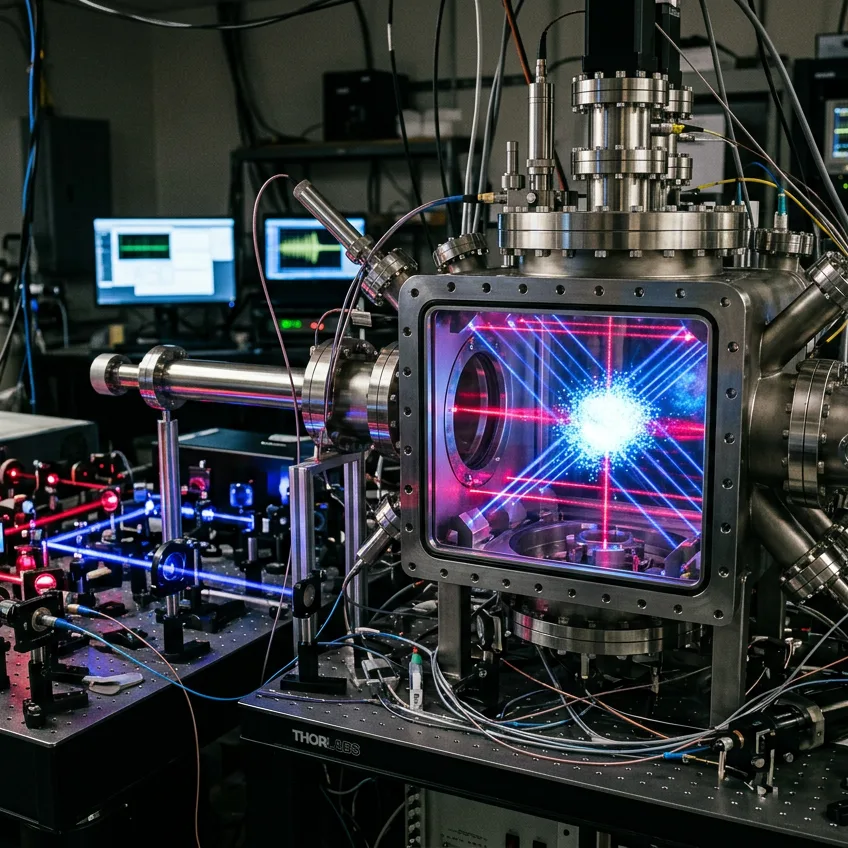
Albert Einstein's theory of general relativity postulated in 1915 that time passes unevenly across the universe: the closer a clock is to a massive gravitational body, the slower its hands move. For decades, this phenomenon could only be verified on macroscopic scales by comparing clocks on Earth with space satellites or airplanes in flight. However, modern quantum metrology has pushed this prediction to an unprecedented extreme.
In 2022, researchers at JILA (a joint institute of NIST and the University of Colorado Boulder) managed to measure gravitational time dilation in an atomic sample separated vertically by just a single millimeter. To achieve this feat, they used an optical lattice atomic clock, a device that suspends around 100,000 neutral strontium atoms in a geometric trap of laser light, cooled to millionths of a degree above absolute zero.
By pointing an ultrastable laser at different heights of this microscopic cloud of atoms, the team detected that the atoms at the bottom aged noticeably slower than those at the top. The height difference of one millimeter caused a gravitational redshift of just a fraction of 10-19. With such precision, this quantum instrument would take more than 300,000 million years—over twenty times the age of the observable universe—to lose a single second. This advance opens the door to 'relativistic geodesy,' a technology capable of exploring underground deposits or magma shifts by measuring the passage of time on the ground.
Source: Nature (Vol. 602, 2022: 'Resolving the gravitational redshift within a millimetre-scale atomic sample') / JILA - NIST