At room temperature, helium is a colorless, inert noble gas. However, when cooled to 2.17 kelvin (-270.98 °C)—a critical threshold known as the lambda point—one of the most unusual phase transitions in physics occurs: helium-4 transforms into a superfluid, a macroscopic quantum state where the ordinary rules of friction cease to operate.
In this state, the liquid completely loses its internal viscosity. Lacking resistance to motion, it exhibits behaviors that seem to defy common sense:
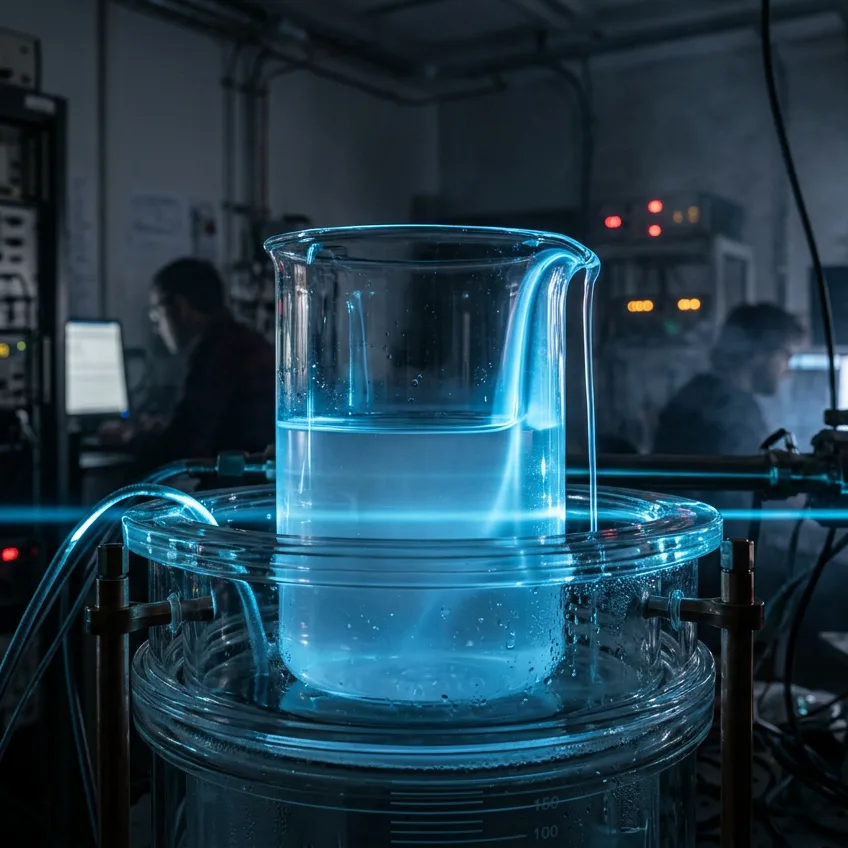
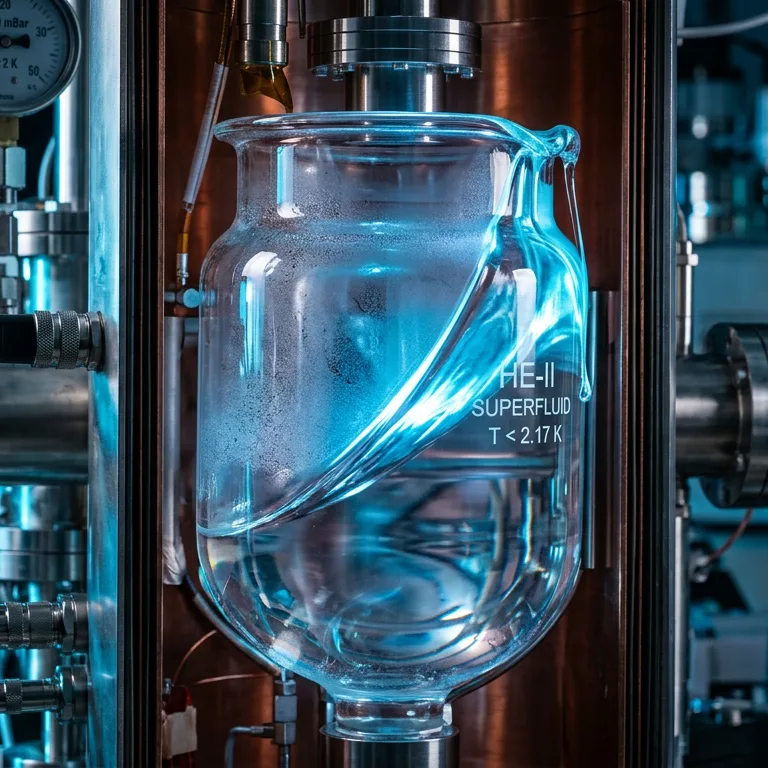
- The Rollin film: Driven by intermolecular attraction forces and the absence of friction, the fluid spontaneously climbs up the inner walls of any open vessel in an invisible film barely thirty nanometers thick. Upon reaching the outer edge, it drips downward until it completely empties the container.
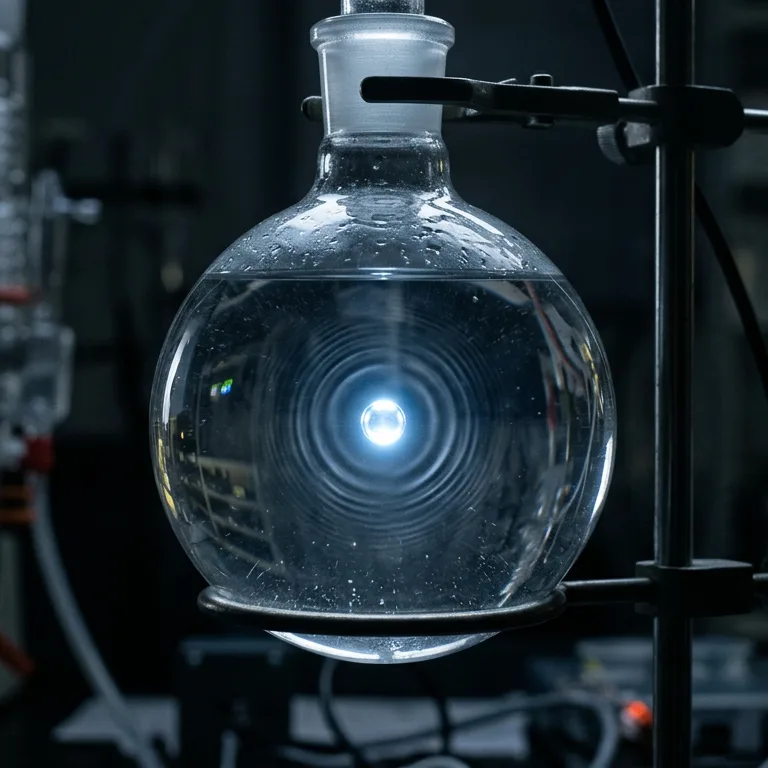
- Eternal whirlpools: If superfluid helium is stirred, it generates quantized microscopic vortices that rotate indefinitely without dissipating energy or ever slowing down.
- The thermomechanical fountain effect: When the bottom of a submerged capillary tube is slightly heated, the liquid rushes toward the heat source with such momentum that it shoots upward, forming an authentic continuous geyser.
Discovered in 1937 by physicists Pyotr Kapitsa, John F. Allen, and Don Misener, this phenomenon was one of the first visual demonstrations of quantum mechanics on a human scale. Today, it is a critical technology for cooling space astronomical detectors and the superconducting magnets of the Large Hadron Collider (LHC) at CERN.
Source: Nature Physics / CERN Accelerator Report (1938, Kapitsa & Allen)