For centuries it was assumed that water only existed in three basic states: vapor, liquid, and conventional ice. However, deep inside giant planets like Uranus and Neptune, water adopts an exotic phase experimentally confirmed in terrestrial laboratories: superionic ice (or ice XVIII).
To synthesize it, a team from the Lawrence Livermore National Laboratory compressed microscopic water droplets between diamond anvils to nearly two million times Earth's atmospheric pressure and bombarded them with high-energy laser pulses. Under these extreme conditions, at more than 4,000 °C, the water did not evaporate; instead, it reorganized into an astonishing hybrid structure:
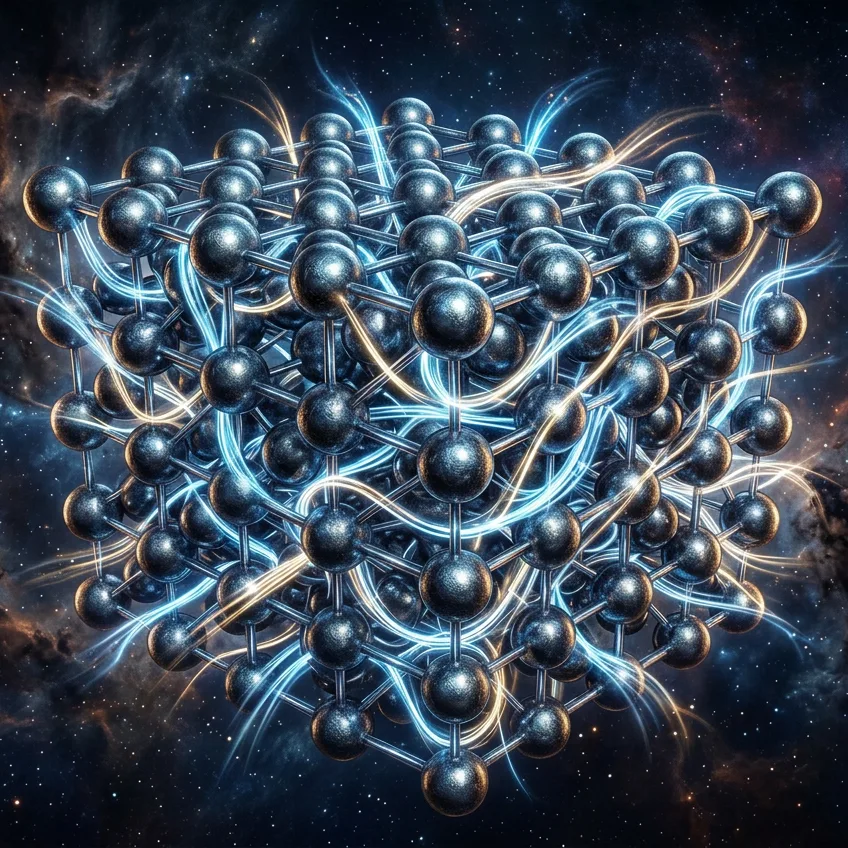
- A solid crystal lattice: Oxygen atoms lock into a rigid cubic lattice, behaving like a solid crystal.
- An ocean of free protons: Hydrogen nuclei separate completely and flow rapidly through the gaps in the oxygen lattice as if they were a liquid.
This physical duality transforms water into a dense, dark, and highly electrically conductive material, similar to a molten metal. Far from being a mere laboratory curiosity, astrophysicists estimate that superionic ice could be the most abundant form of water in our solar system, making up thousands of kilometers of planetary mantles and explaining the enigmatic off-center magnetic fields of the ice giants.
Source: Nature / Lawrence Livermore National Laboratory