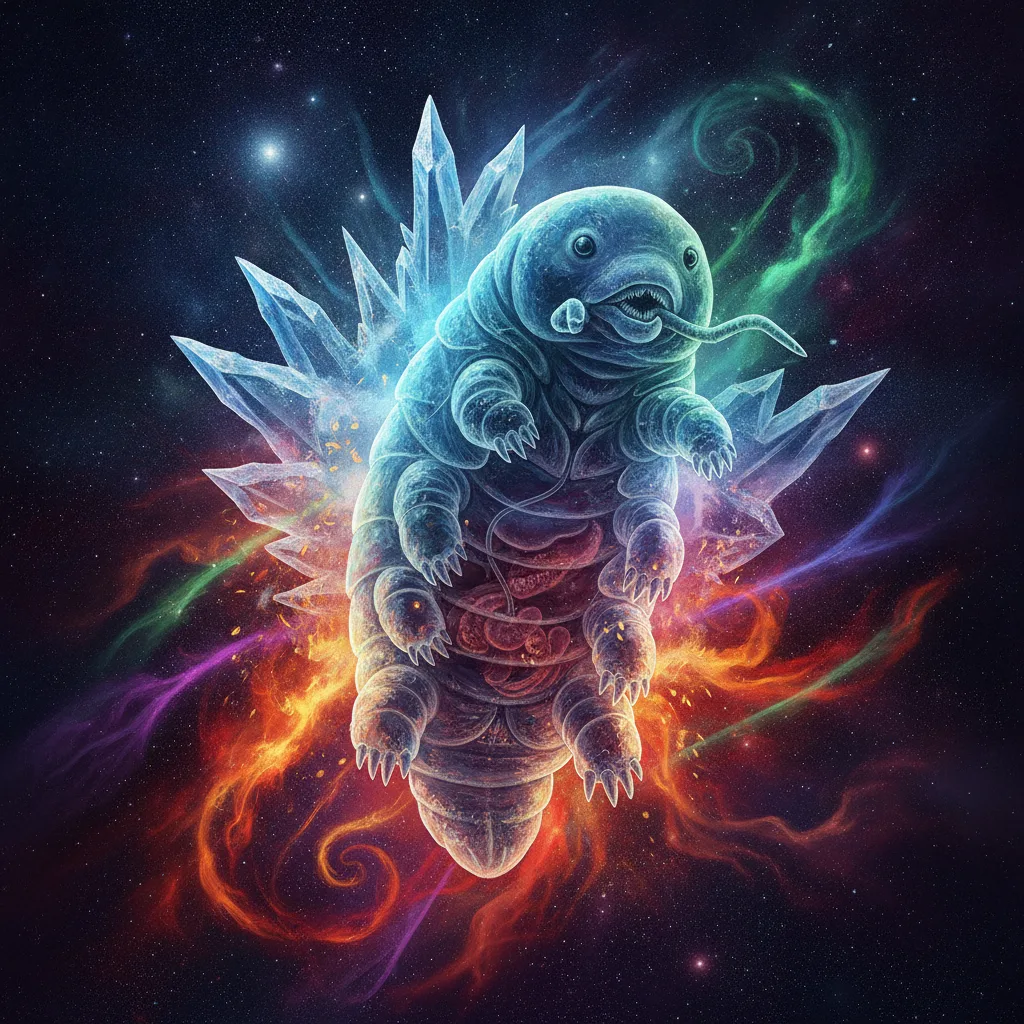
Imagine a living organism that can survive in the vacuum of space, at temperatures near absolute zero, or in boiling water. This is not a science fiction character, but the tardigrade, also known as the 'water bear'. These microscopic invertebrates, which rarely exceed half a millimeter in length, are considered the most resilient animals on the planet.
Their secret lies in a process called cryptobiosis, a state of suspended animation. When conditions become extreme (dehydration, cold, heat, pressure, or radiation), tardigrades curl up, lose almost all their water, and form a 'tun', a kind of indestructible barrel. In this state, their metabolism drops to 0.01% of normal.
They have proven capable of surviving:
- Temperatures from -272°C (near absolute zero) to over 150°C.
- Pressures exceeding 6,000 atmospheres, equivalent to the deepest ocean trenches.
- Radiation levels that exceed a thousand times the lethal dose for humans.
- Near-total dehydration, reviving decades later upon rehydration.
- And most astonishingly, direct exposure to the vacuum and radiation of space, as demonstrated on the 2007 FOTON-M3 mission.
These 'survivors' inspire scientists working to understand the limits of life and develop new ways to protect biological materials.
Source: National Geographic, Scientific American, ESA (European Space Agency)