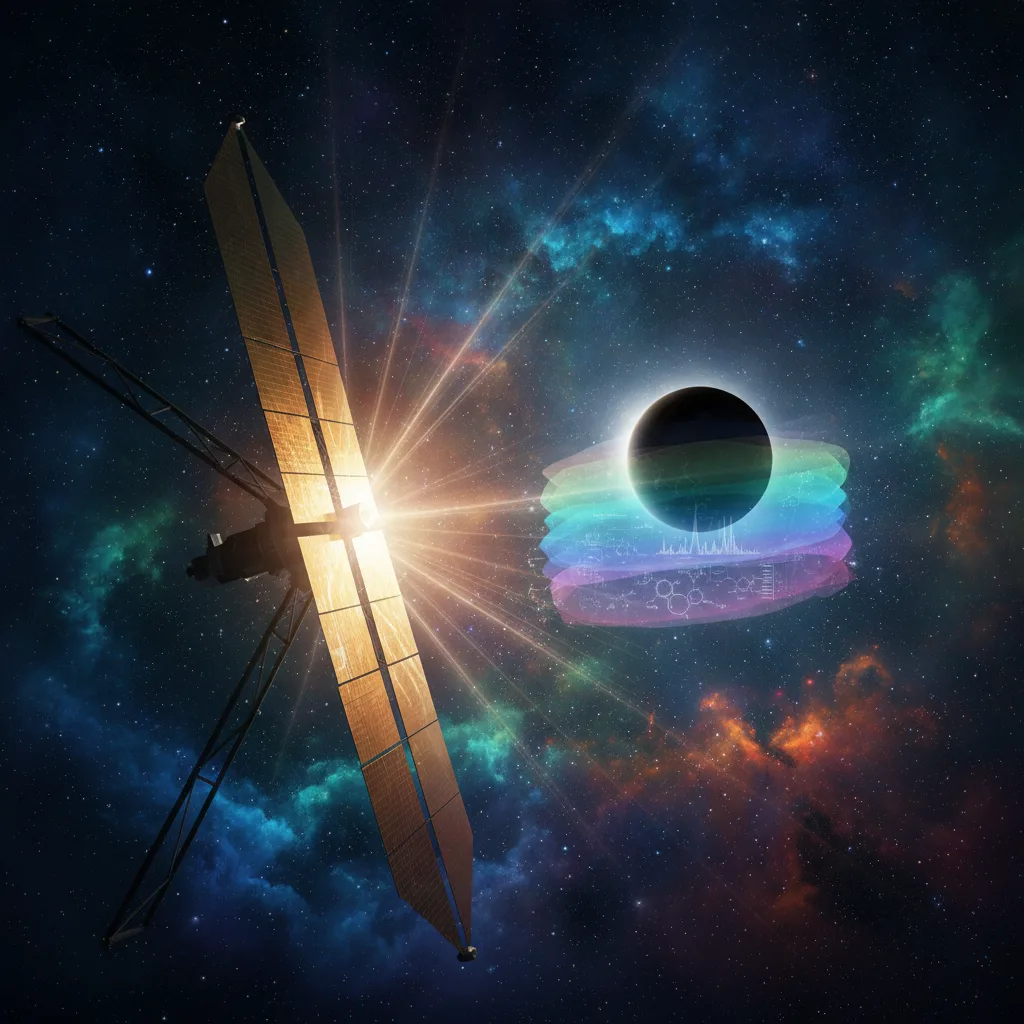
The James Webb Space Telescope (JWST) not only offers us spectacular images of the early universe, but it also acts as a sophisticated "atmosphere reader" for exoplanets, worlds beyond our solar system. Its extraordinary ability to observe in the infrared spectrum allows it to analyze the chemical composition of planetary atmospheres billions of kilometers away.
When an exoplanet transits or passes in front of its host star from our perspective, starlight passes through its atmosphere. During this event, molecules present in the planet's atmosphere absorb specific wavelengths of that starlight. The JWST captures this filtered light and breaks it down into a spectrum, revealing chemical "fingerprints" that correspond to elements and compounds such as water vapor, methane, carbon dioxide, and even, potentially, oxygen.
This transit spectroscopy technique is a revolutionary tool in astrobiology. It has already allowed the JWST to detect water vapor and silicate clouds in the atmospheres of gas giants like WASP-96 b, and it is laying the groundwork for future searches for biosignatures: gas combinations that could indicate the presence of life on smaller rocky planets. Deciphering these "cosmic letters" brings us one step closer to answering the age-old question: Are we alone in the universe?
Source: NASA (official JWST website), ESA, Astrophysical Journal