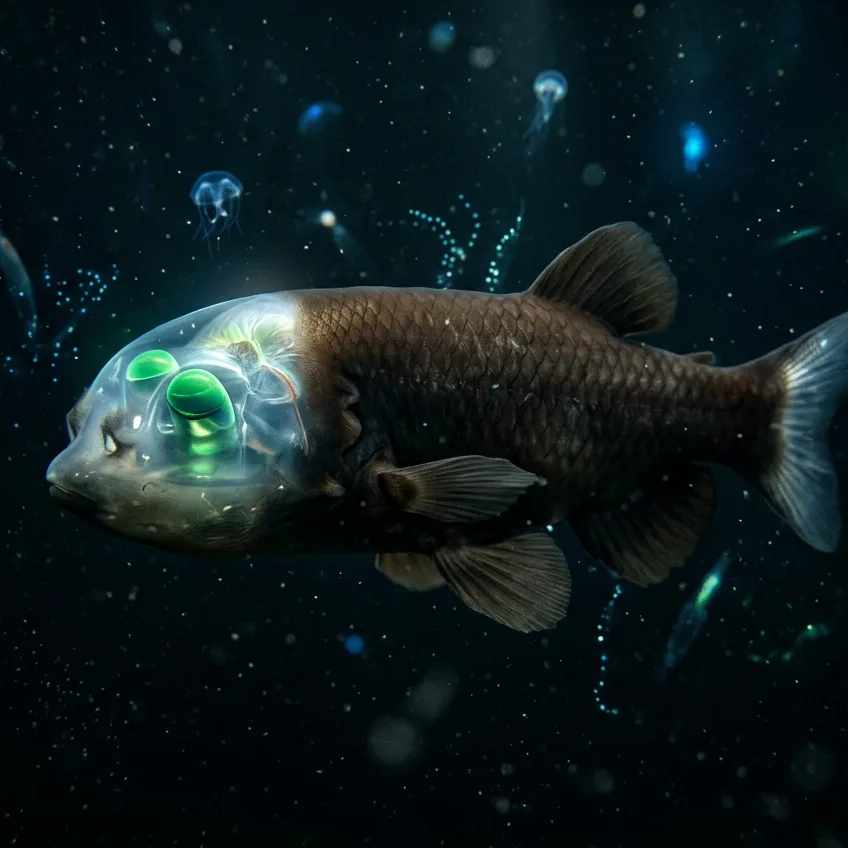
At more than 600 meters deep in the Pacific Ocean, where sunlight is a faint memory, lives one of the most unusual vertebrates in the animal kingdom: the barreleye fish (Macropinna microstoma). Although the species was first classified in 1939, it was not until the year 2004 that scientists from the Monterey Bay Aquarium Research Institute (MBARI) managed to film it alive in its habitat, revealing an anatomical secret that baffled marine biology.
What appear to be eyes at first glance on the front of its face are actually nares, olfactory passages similar to human nostrils. Its real eyes are two tubular emerald-green spheres housed inside a transparent fluid-filled dome covering the top of its skull. This unique structure provides crucial advantages for surviving in the abyssal gloom:
- 90-degree visual rotation: Its eyes can point vertically toward the surface to track prey silhouettes and rotate forward to focus on food when it opens its small mouth.
- Specialized optical filters: The green pigments in its lenses have the ability to filter out scarce residual sunlight, allowing it to distinguish the bioluminescent glow of floating jellyfish and siphonophores.
- Biological shield: The translucent dome protects its hyper-delicate visual organs from the stinging venom of marine tentacles while it steals their food.
The barreleye fish remains almost motionless in the water column thanks to its wide stabilizing fins, demonstrating how the relentless pressure of the abyss can sculpt fascinating evolutionary solutions.
Source: Monterey Bay Aquarium Research Institute (MBARI)