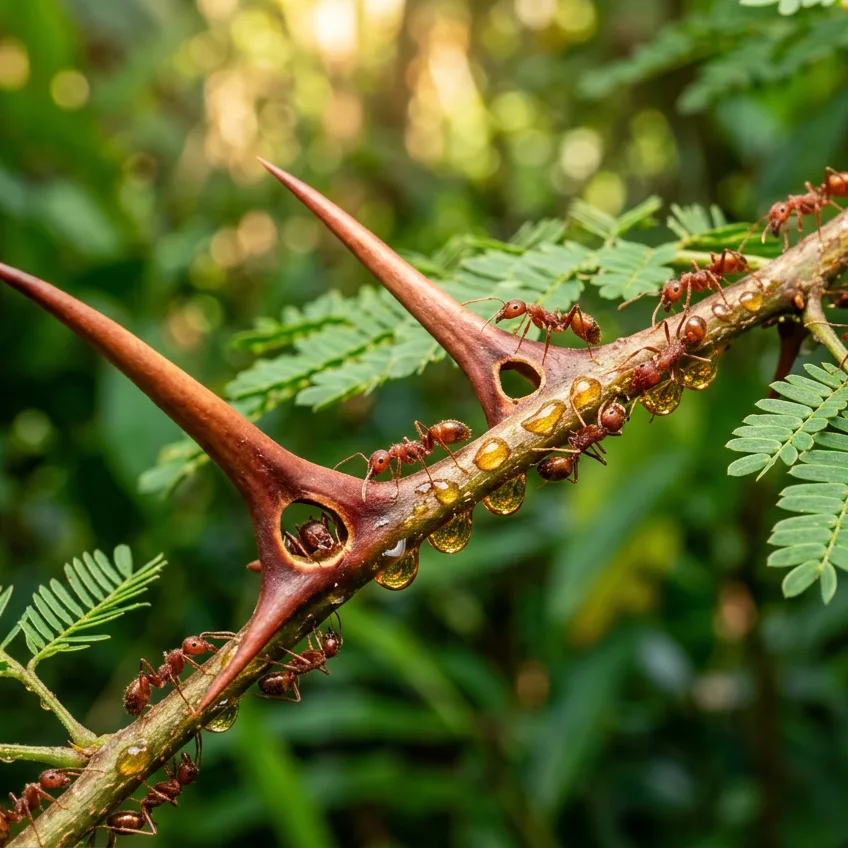
For decades, the relationship between the bullhorn acacia (Vachellia cornigera) and ants of the genus Pseudomyrmex was cited in biology textbooks as the prime example of peaceful cooperation. The deal seemed flawless: the tree provides shelter inside its colossal hollow thorns and nourishment through nectar and nutritious appendages called Beltian bodies. In exchange, a legion of fiercely aggressive ants patrols the branches around the clock, devouring caterpillars, cutting invasive vines, and violently stinging any mammal that dares brush against the bark.
However, in 2013, a team of researchers led by ecologist Martin Heil discovered that this idyll concealed a dark biochemical trick: the acacia enslaves its defenders through physiological manipulation. Upon emerging as adults, the ants possess an enzyme called invertase, essential for breaking down sucrose found in the nectar of the vast majority of forest flowers. But the nectar secreted by the acacia contains inhibitory substances that irreversibly block and destroy the insects' invertase.
To ensure they do not perish, the tree offers nectar that already contains predigested sugars (glucose and fructose). The outcome is a perfect metabolic trap: as soon as a young ant drinks from the acacia for the first time, it loses forever the ability to process outside sugars. If it tried to defect and forage on another plant, it would starve to death. The tree does not merely pay for protection; it hacks the digestive system of its army to guarantee absolute and permanent loyalty until death.
Source: Study by Martin Heil and collaborators in Ecology Letters (2013): 'Ants chemically held captive by acacia host'.