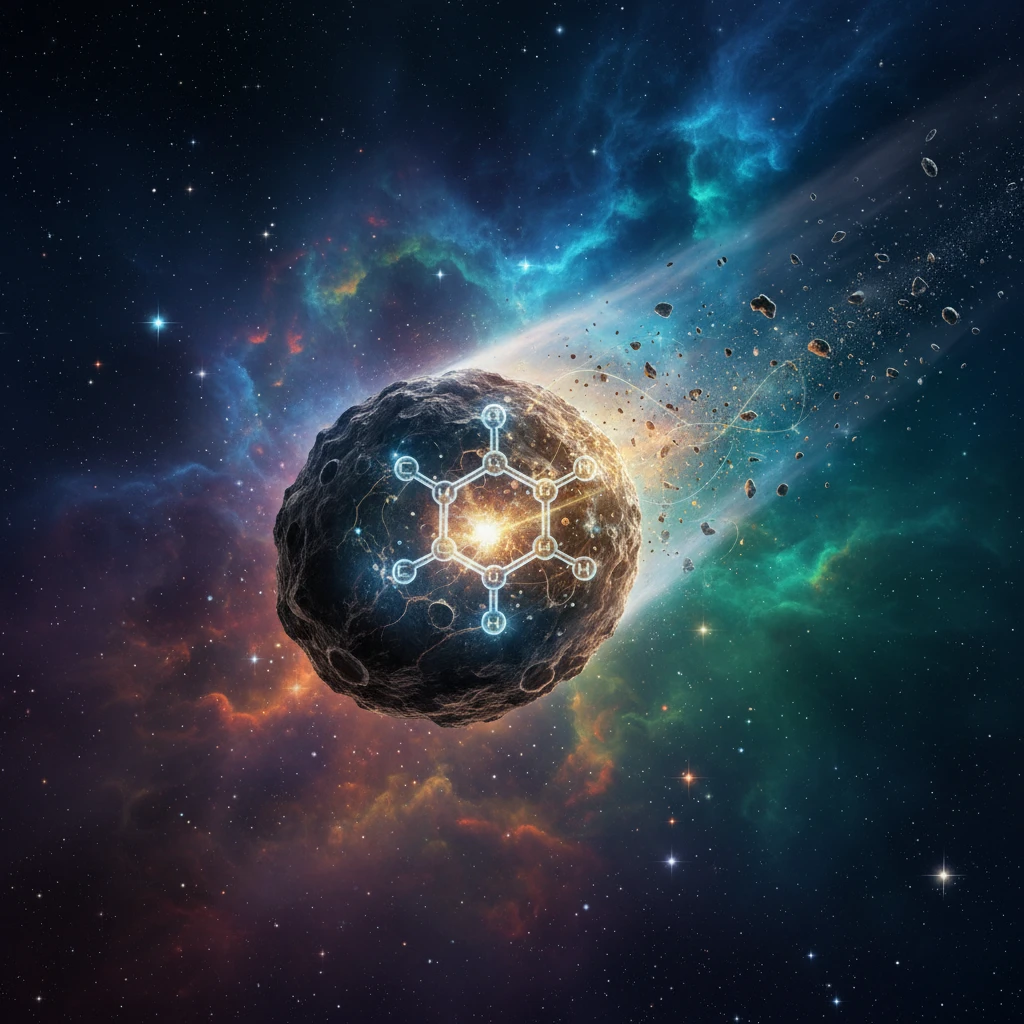
A team of astronomers from the Max Planck Institute for Nuclear Physics, using the ALMA telescope in Chile, detected in 2021 the presence of ribose, a fundamental sugar for life, in a red giant star 12,000 light-years away. This finding follows the previous confirmation of the existence of glyceraldehyde and other simple sugars in comets and meteorites.
Ribose is a key component of RNA (ribonucleic acid), the molecule that not only carries genetic information, but can also catalyze chemical reactions. Its presence in interstellar space suggests that the building blocks of life were not formed exclusively on early Earth, but could have been seeded by materials coming from the cosmos during the Late Heavy Bombardment, around 3,800 million years ago.
This discovery strengthens the hypothesis of panspermia, which proposes that the basic components of life, and even microorganisms, could travel between planets and star systems, attached to cosmic dust or inside rocks. If complex sugars form naturally in nebulae and are incorporated into celestial bodies, the probability of life arising on any planet with suitable conditions increases exponentially.
Source: Max Planck Institute for Nuclear Physics / ALMA Observatory (Atacama Large Millimeter/submillimeter Array). Study published in the journal Science Advances, 2021.