For more than a century, representations of chemical bonds in textbooks and on blackboards were considered convenient educational abstractions: schematic lines drawn to symbolize the sharing of electrons between neighboring atoms. However, in 2009, a team of physicists at IBM Research – Zurich, led by Leo Gross, achieved what seemed to defy the laws of optics: obtaining the first direct, indisputable photograph of the internal structure and chemical bonds of an individual molecule.
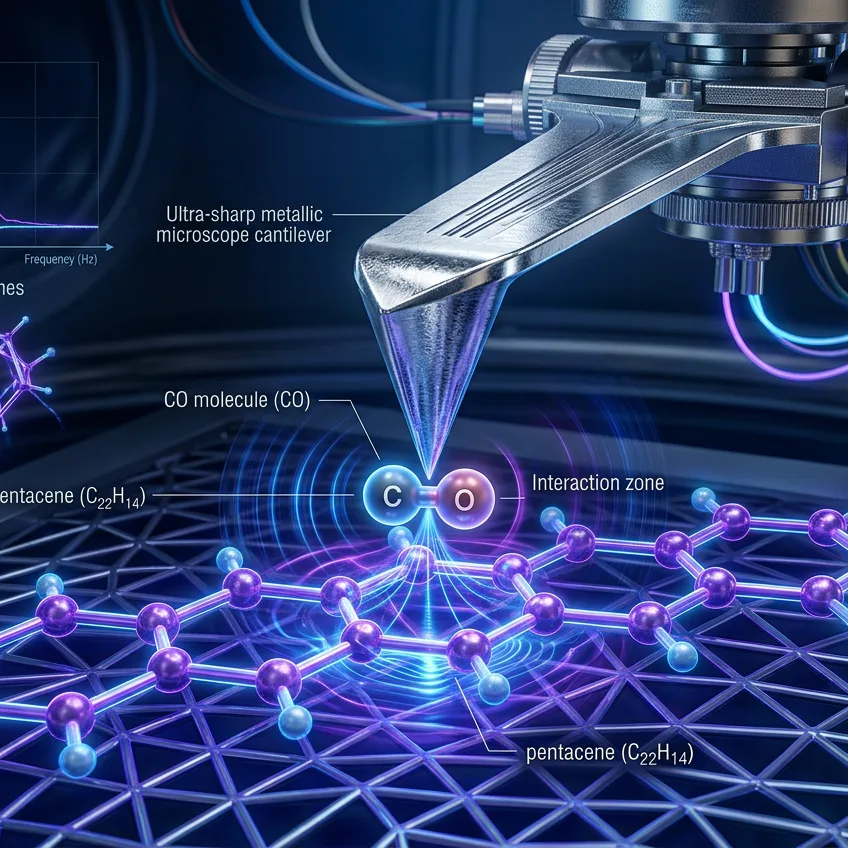
To accomplish this feat, the scientists used an Atomic Force Microscope (AFM) operating at five Kelvin above absolute zero (-268 °C) under ultra-high vacuum conditions. The key to their success lay in an unprecedented nanotechnological trick: they lowered the instrument's silicon tip until a single carbon monoxide (CO) molecule adhered to its end. The downward-facing oxygen atom acted as an ultra-stable, chemically inert atomic probe that was so sharp its thickness was that of a single particle.
When scanning a pentacene molecule (five interlocking benzene rings) with this tiny needle, the quantum Pauli repulsion force between the electrons of the tip and those of the sample deflected the sensor with picometer precision. The resulting map revealed with absolute clarity not only the positions of the twenty-two carbon atoms, but also the electron densities that form the covalent bonds, visually confirming the theoretical models that science had deduced blindly for one hundred years.
Source: Science journal (Gross et al., 2009: 'The Chemical Structure of a Molecule Resolved by Atomic Force Microscopy')