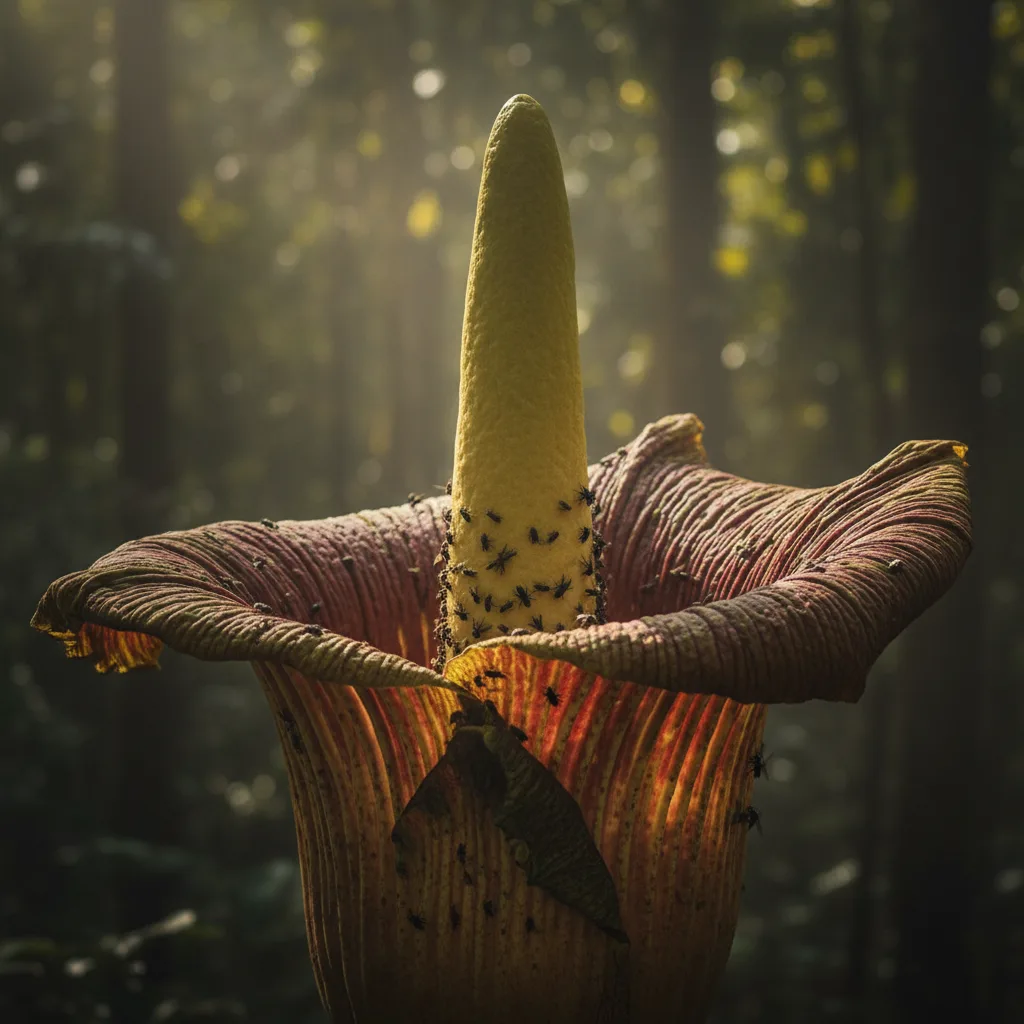
Deep in the rainforests of Sumatra, Indonesia, blooms one of the most extraordinary and olfactorily challenging wonders of the plant kingdom: Amorphophallus titanum, commonly known as the "corpse flower." This plant, which can reach heights of over 3 meters, is famous not only for its monumental size, but also for the peculiar aroma it emanates during its brief blooming period, which usually lasts just 24 to 48 hours.
Contrary to expected floral sweetness, Amorphophallus titanum releases a nauseating odor reminiscent of rotting meat. This "perfume" is not accidental; it is an ingenious evolutionary strategy to attract its natural pollinators: carrion flies and beetles that normally lay their eggs on dead animals. By mimicking the smell of decay, the flower deceives these insects, which flock to the plant, carrying pollen from one flower to another and thus ensuring the reproduction of the species.
Heat also plays a crucial role. The corpse flower's inflorescence is capable of generating its own heat, which helps disperse the foul aroma over greater distances, attracting insects from farther away. Its blooming is an event as rare as it is spectacular, occurring only a few times in its approximately 40 years of life, making it a true marvel of biological adaptation and a fascinating testament to nature's intelligence.
Source: National Geographic, New York Botanical Garden (NYBG)