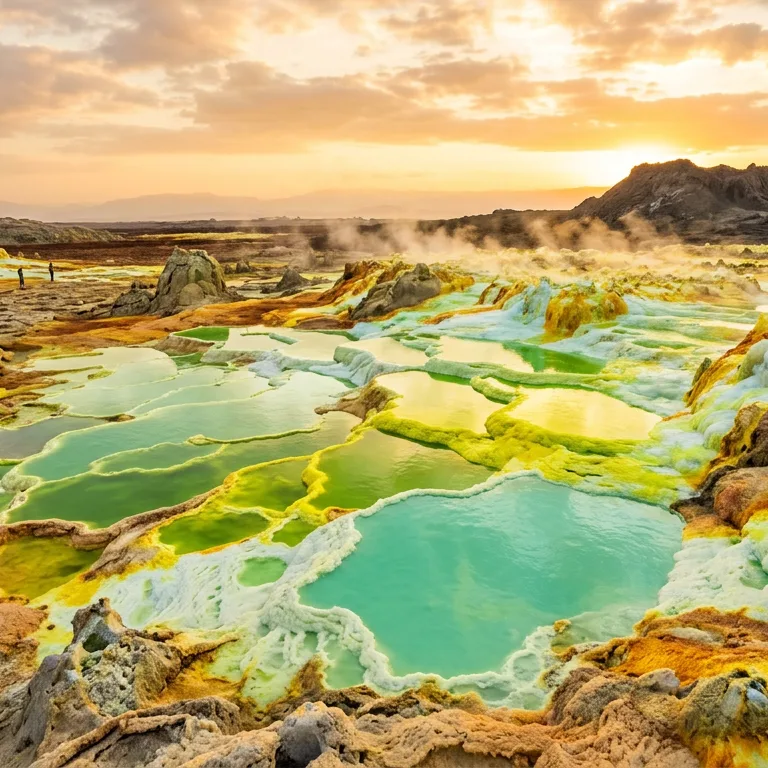
In northeastern Ethiopia lies one of the most extreme points on Earth's crust: the Danakil Depression, located within the so-called Afar Triangle. At about 125 meters below sea level and with ambient temperatures frequently exceeding 50 °C, this basin is not just a hostile landscape, but a direct window into the geological birth of a future ocean.
Beneath its surface operates a unique tectonic triple junction, where the African (Nubian), Somali, and Arabian plates converge. These continental masses are drifting away from each other at a rate of 1 to 2 centimeters per year. As the lithosphere stretches, the Earth's crust has thinned to just 20 kilometers thick, compared to the usual 40 in continental crust.
This extreme thinness allows magma to rise almost to the surface, fueling extraordinary phenomena:
- Dallol: A hydrothermal complex with sulfur vents, brine pools with a pH of almost zero (as acidic as gastric juice), and neon green and rust tones.
- Erta Ale: One of the most active shield volcanoes in the world, which has hosted an almost permanent glowing basaltic lava lake for decades.
Geologists estimate that in about 10 million years, the fracture will be so deep that the waters of the Red Sea and the Gulf of Aden will completely flood the basin, splitting Africa in two and turning this hell of salt into a brand-new ocean.
Source: Geological Society of America / Nature Geoscience