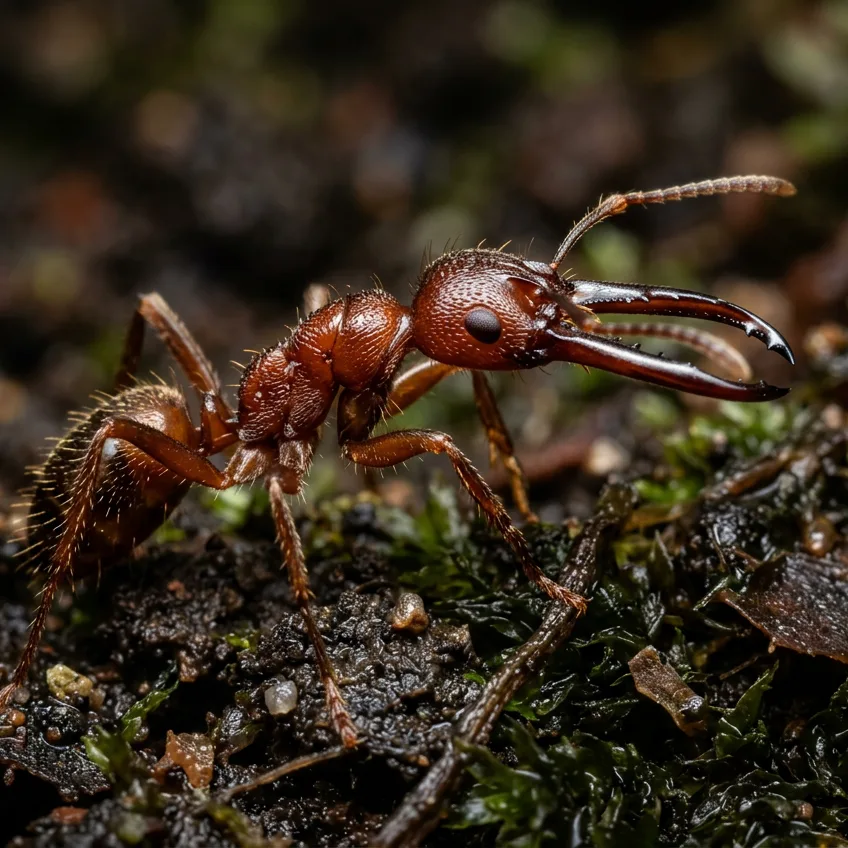
In the tiny underworld of tropical leaf litter lives a creature with an extraordinary biomechanical record: the Dracula ant (Mystrium camillae). While the blink of a human eye takes approximately 300 milliseconds, this subterranean species performs the fastest anatomical action ever recorded on the planet: a mandibular snap completed in just 23 microseconds (0.000023 seconds).
Unlike other ants that open their jaws wide to snap them shut, Mystrium camillae uses an ingenious spring-loaded system similar to snapping fingers. The ant presses the tips of its mandibles tightly against each other, slightly deforming its exoskeleton and loading mechanical tension. The moment one mandible slips past the other, the stored energy releases instantly, reaching speeds over 90 meters per second (around 324 km/h).
This burst produces an acceleration of more than 100,000 G, enough to instantly stun or dismember centipedes and hard-shelled prey. The power is so extreme that the recoil force often flings the ant itself several centimeters backward through the air.
Its eerie name comes not only from this lethal strike, but also from its unique feeding behavior: unable to digest solid prey on their own, adult ants feed the catch to their larvae and then practice non-destructive parasitism, gently piercing the skin of their offspring to feed on their hemolymph without killing them.
Source: Royal Society Open Science (2018) / Smithsonian Tropical Research Institute