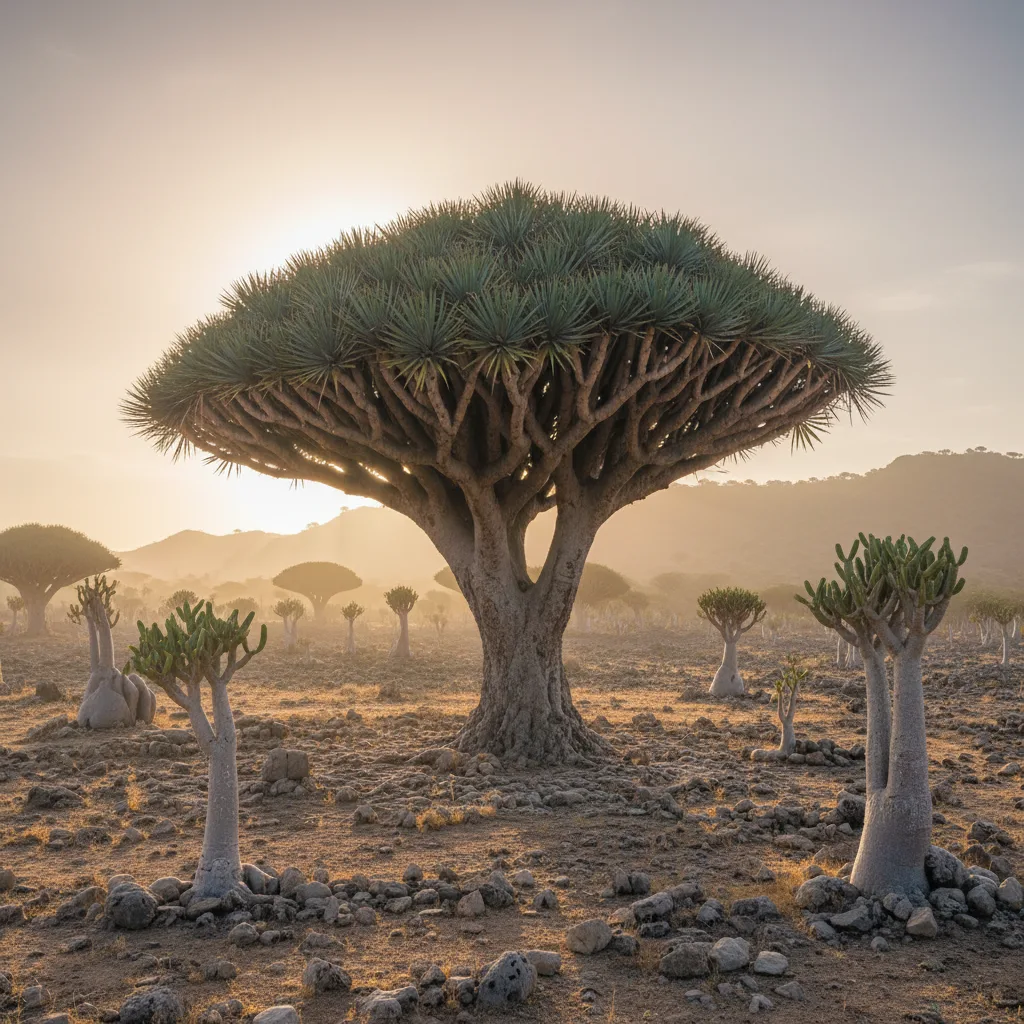
On the remote island of Socotra, part of Yemen in the Indian Ocean, there is a tree that seems straight out of a fantasy tale: Dracaena cinnabari, commonly known as the "dragon's blood tree". Its distinctive silhouette, with a dense crown shaped like an inverted umbrella, is a unique adaptation to capture moisture from fog in a semi-arid ecosystem, a crucial strategy for its survival in this extreme environment. This "living fossil" is one of the most iconic symbols of Socotra's exceptional biodiversity, often described as the "Galapagos of the Indian Ocean".
The most fascinating aspect of this tree is its sap. When a cut is made in its bark, the tree exudes a deep red resin, giving it its poetic name "dragon's blood". This resin has been valued since antiquity by various cultures. Ancient Romans and Greeks used it for medicinal purposes, as a dye, and in rituals. Even today, in local traditional medicine, it is believed to have healing, astringent, and anti-inflammatory properties. Scientifically, the resin has been shown to contain antioxidant and antimicrobial compounds. The longevity of these trees is also impressive, with some specimens estimated to be hundreds, or even thousands, of years old. Its singular beauty and rarity make it an emblematic species and a living testimony to nature's incredible adaptability.
Source: National Geographic, Botanic Gardens Conservation International (BGCI), Journal of Ethnopharmacology



