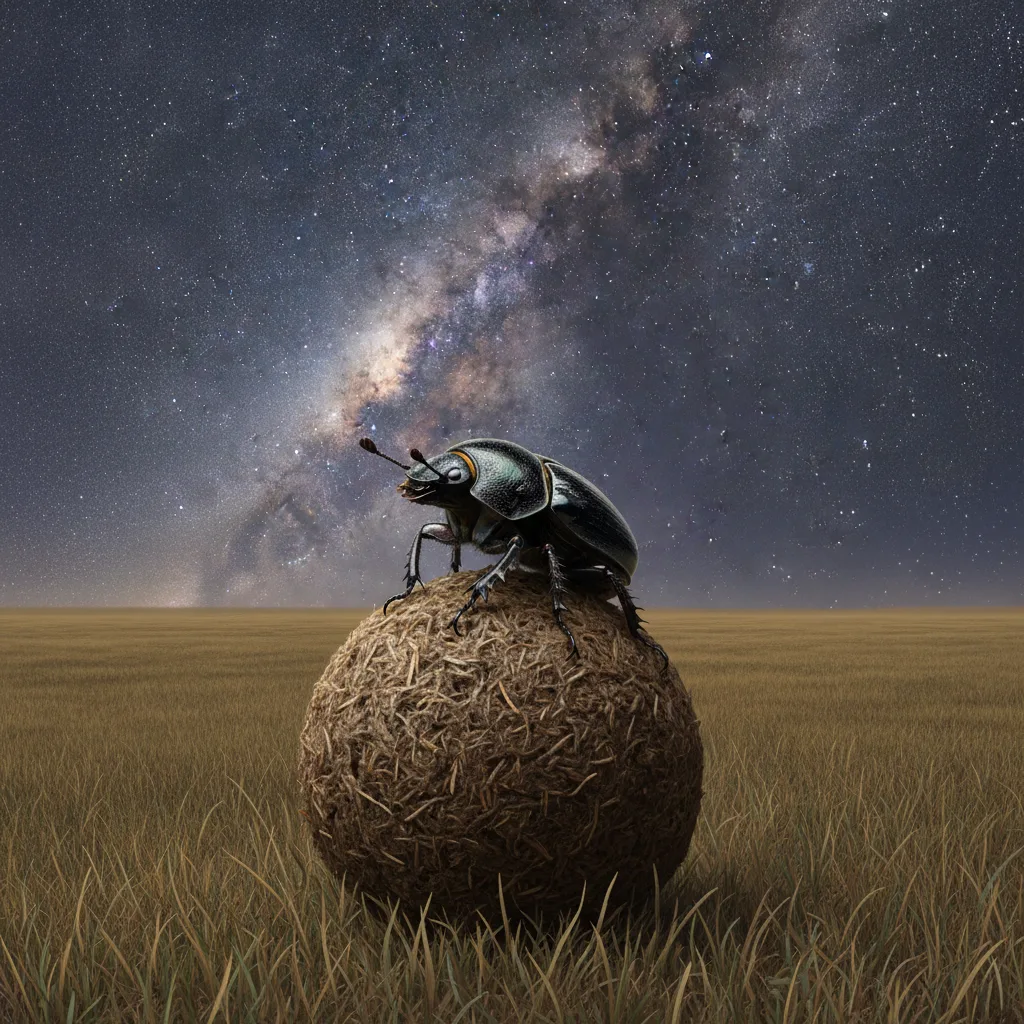
Imagine a tiny insect rolling a ball of dung and using the Milky Way as a compass! Dung beetles, especially the African species Scarabaeus satyrus, are masters of orientation, a crucial skill to quickly escape with their prized cargo and avoid competition. Their navigation method is so sophisticated that it rivals that of any human explorer.
When a dung beetle finds a pile of fresh dung, it shapes a perfect ball and then must move away from it in a straight line. Veering off would mean going in circles and wasting valuable time. To make sure they stay on course, these dung engineers have a fascinating trick: they climb onto their ball, performing a sort of orienting "dance" that allows them to scan the sky.
Research from Lund University in Sweden has revealed that, in addition to using polarized sunlight during the day and the moon at night, on moonless nights dung beetles steer their way using the diffuse light pattern of the Milky Way. They are the only known animals that rely on our galaxy to orient themselves. Experiments in artificial planetariums, where the visibility of the stars and the Milky Way was manipulated, showed that the beetles maintained straight paths only when the galactic "stripe" was visible. This ability demonstrates amazing visual sensitivity and neuronal sophistication in a brain measuring just a few millimeters.
This curiosity not only highlights the incredible diversity of adaptations in nature, but also reminds us that even the smallest beings can possess abilities that challenge our understanding and force us to look at the world, and the cosmos, with new eyes.
Source: National Geographic, ScienceDirect (research from Lund University on dung beetles and stellar navigation).