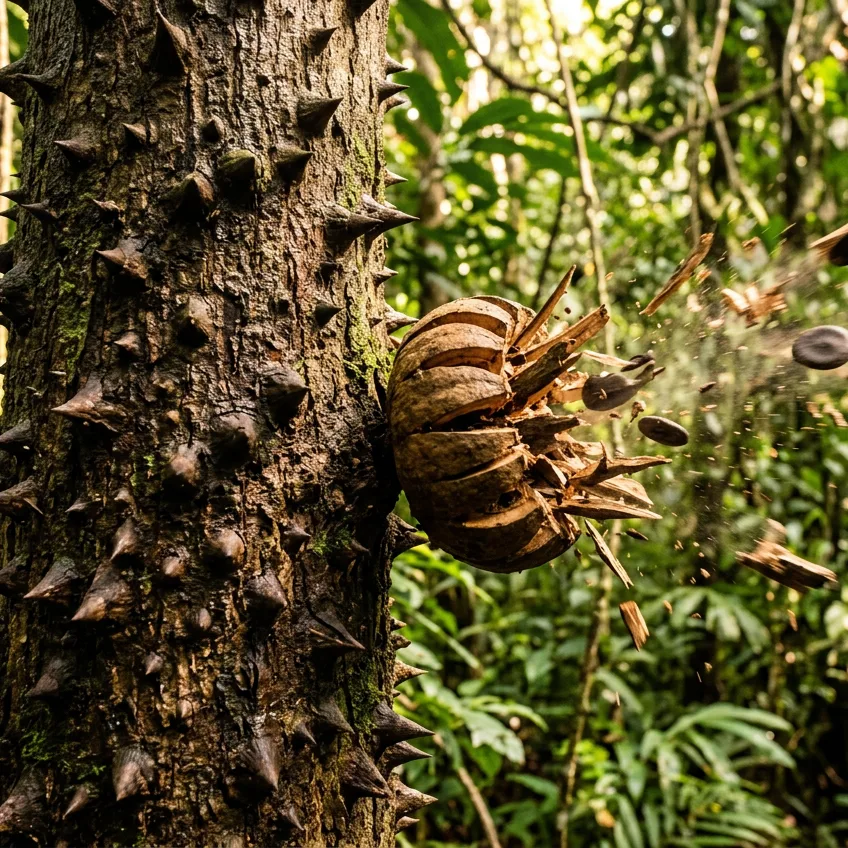
In the tropical rainforests of the Americas lives one of the most feared and fascinating trees in the plant kingdom: Hura crepitans, commonly nicknamed the dynamite tree or the sandbox tree. At first glance, it looks like a creature out of a botanical nightmare, featuring a trunk heavily armored with thousands of sharp triangular spines and a caustic sap so virulent that indigenous Carib hunters used it to tip their poison arrows, and which can cause temporary or permanent blindness upon contact with human eyes.
However, its most extraordinary adaptation occurs during reproduction. Unlike plants that rely on the wind, insects, or birds to spread their seeds, Hura crepitans resorts to a violent ballistic solution. Its fruits, which feature a segmented woody structure reminiscent of a small pumpkin, accumulate colossal hygroscopic mechanical tension as they mature and dehydrate in the tropical heat.
When the fruit reaches a critical level of desiccation, the sutures between its carpels suddenly collapse:
- The detonation: The capsule bursts with a loud crack identical to a gunshot, audible hundreds of meters away in the quiet of the jungle.
- Ballistic speed: The disc-shaped seeds are ejected at over 70 meters per second (around 250 km/h).
- Lethal range: The projectiles are launched in all directions, reaching distances of up to 45 meters from the trunk, with enough force to pierce thick foliage or seriously injure any animal in their path.
Source: Swaine, M. D., & Beer, T. (1977). 'Explosive Seed Dispersal in Hura crepitans L. (Euphorbiaceae)'. New Phytologist.



