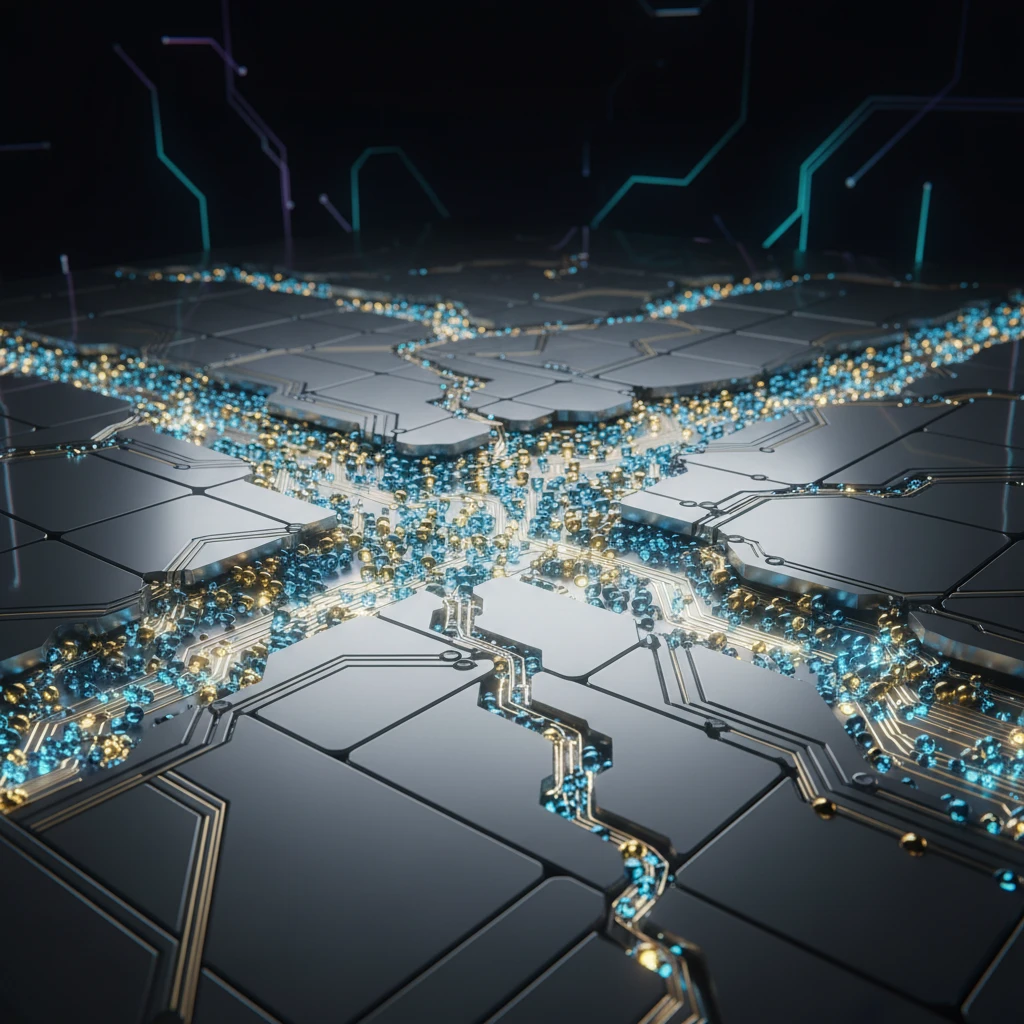
A team of physicists at the Massachusetts Institute of Technology (MIT) has recently demonstrated that time crystals, a phase of matter theoretically predicted in 2012 and first created in 2016, can interact with gravity in ways that challenge classical physics. These crystals, which are structures that repeat in time without dissipating energy, showed in 2023 experiments that their periodic behavior is affected by extremely weak gravitational fields, such as those generated by objects of just a few grams at millimeter distances.
Most surprisingly, this effect only occurs when time crystals are cooled to temperatures close to absolute zero (-273.15°C), where quantum effects dominate. Researchers suggest this could be a clue toward the long-sought theory of quantum gravity, which would unify quantum mechanics with Einstein's general relativity. The experiment used a time crystal made of ytterbium ions trapped in a near-perfect vacuum, with sensors capable of detecting gravitational fluctuations of just 10^-12 newtons.
This research, published in the journal Nature Physics, opens new doors to understanding how spacetime behaves at atomic scales, and could have future applications in quantum computing and quantum medicine.
Source: Nature Physics, MIT News, Revista Science