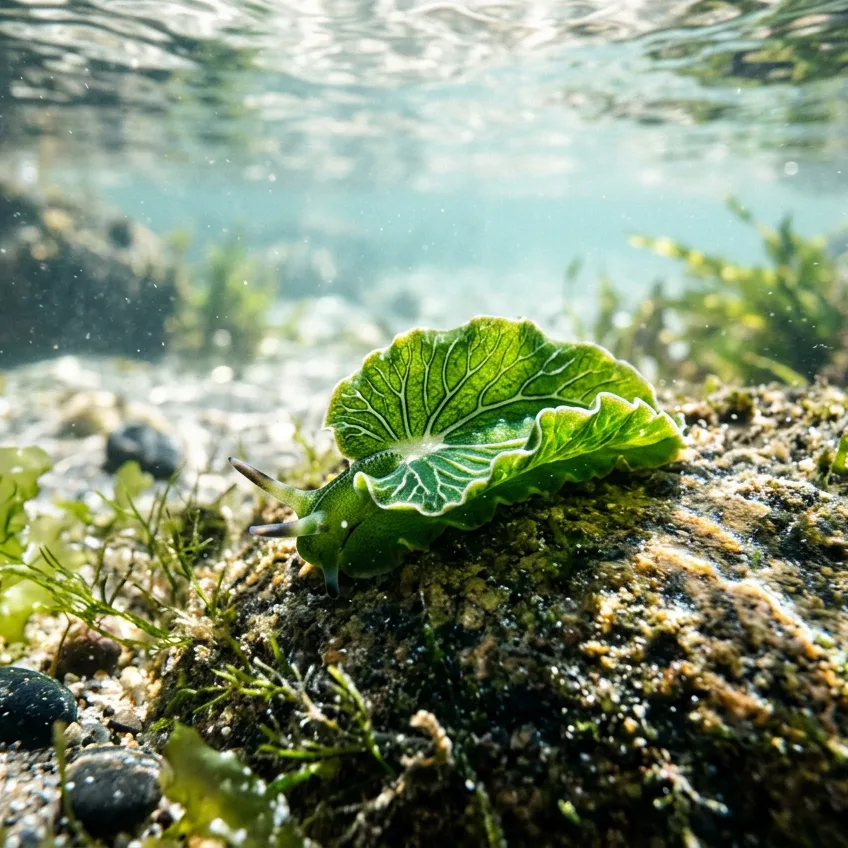
In the salt marshes of North America's Atlantic coast lives an organism that seems to challenge the fundamental laws of biology: the sea slug Elysia chlorotica. Although it is born as a translucent, heterotrophic mollusk, this small, leaf-shaped animal eventually takes on an intense green color and the amazing ability to nourish itself directly from sunlight.
This phenomenon is known scientifically as kleptoplasty. When the slug feeds on the intertidal alga Vaucheria litorea, it does not completely digest its cells. Instead of breaking down the chloroplasts—the tiny cellular engines where photosynthesis occurs—its digestive system absorbs them intact and stores them inside the cells lining its intestinal branches.
What is truly extraordinary is the longevity of this mechanism:
- Solar autonomy: After feeding on algae during the first weeks of its life, an adult slug can survive for 9 to 10 months without ingesting any additional solid food, relying exclusively on solar energy and the carbon fixed by the stolen chloroplasts.
- Genetic support: Scientists discovered that the slug not only retains the organelles, but has also incorporated algal genes into its own genome to produce the proteins necessary to keep the chloroplasts active.
This unusual mollusk represents one of the few documented examples of a functionally photosynthetic animal, brilliantly blurring the dividing line between the animal and plant kingdoms.
Source: Proceedings of the National Academy of Sciences (PNAS), study on kleptoplasty and gene transfer in Elysia chlorotica.