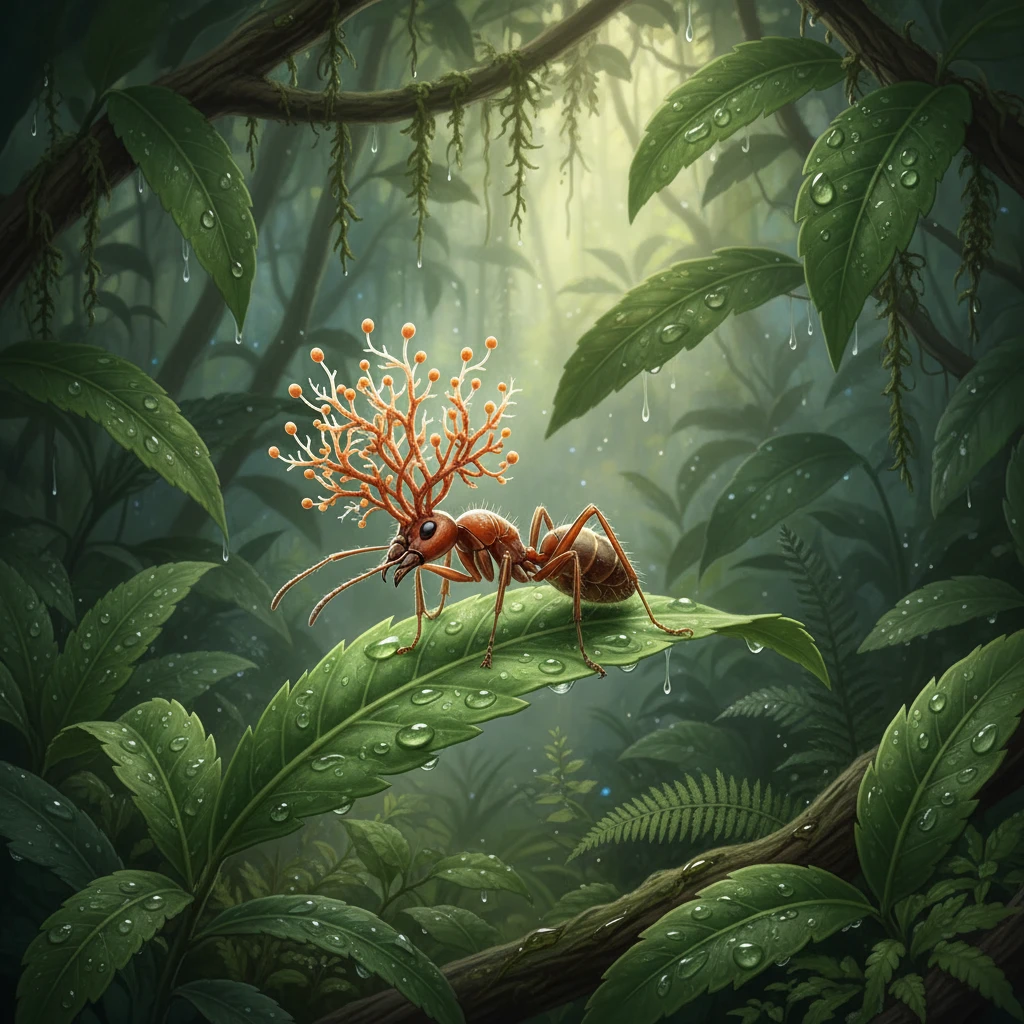
The fungus Ophiocordyceps unilateralis, known as the "zombie fungus," has developed one of the most complex parasitic strategies in the natural kingdom. After infecting a worker ant, the fungus does not kill it immediately, but instead hijacks its nervous system through a secretion of specific alkaloids.
What is truly fascinating is the programmed behavior it induces. The infected ant abandons its colony and climbs a plant, seeking an optimal position (generally at a height of 25 cm with a humidity of 94-95%). There, it bites down hard on a leaf vein with its mandibles, locking itself in place forever. This final act, called "the death grip," occurs between 12:00 and 3:00 PM, when conditions are ideal for dispersal.
Once anchored, the fungus consumes the internal tissues and sprouts from the ant's head, forming a stroma that releases spores over the colony's foraging trail. A single stroma can release up to 30,000 spores per hour, infecting new victims. Recent studies at Harvard University have identified that the fungus manipulates more than 1,000 genes in the ant to achieve this total control, turning it into a "biological bomb" that guarantees its evolutionary survival.
Source: Study by Harvard University (2017) on gene manipulation in ants infected by Ophiocordyceps.