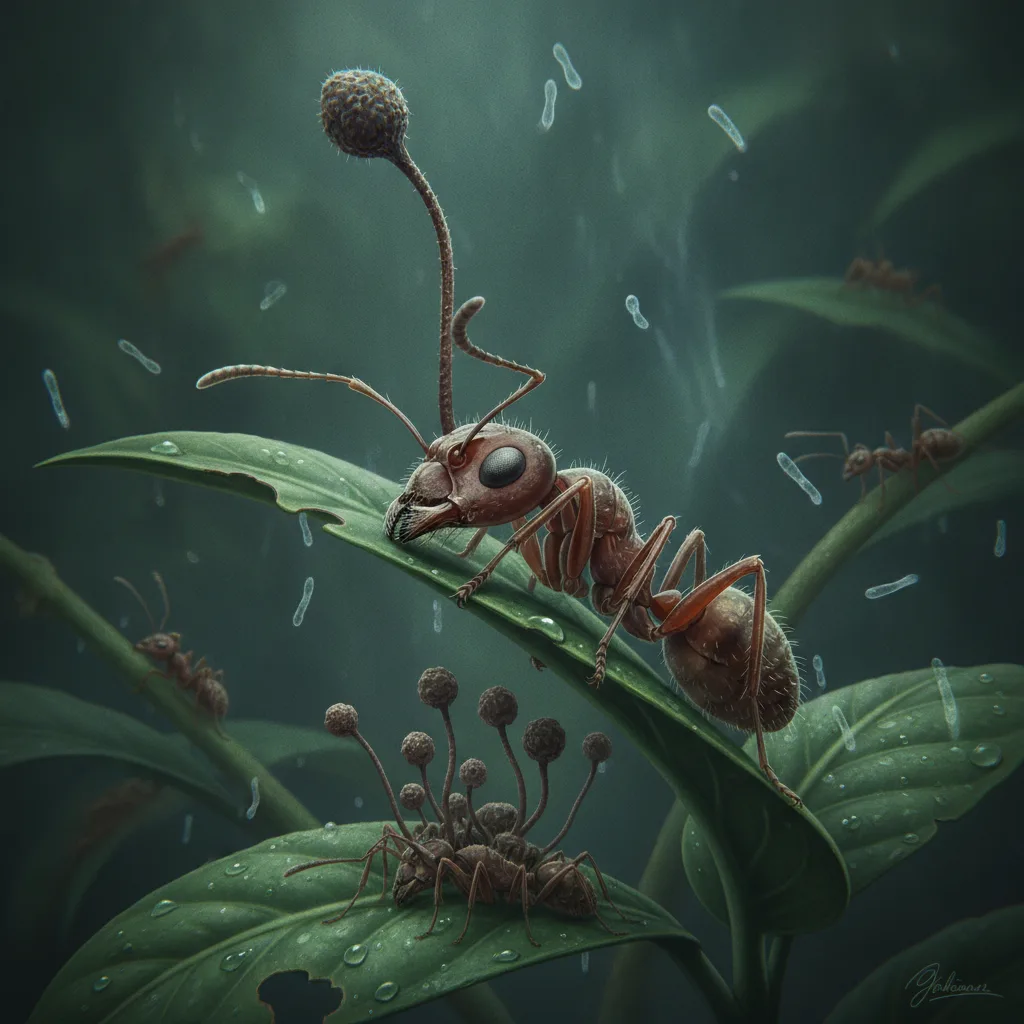
Deep in the tropical rainforest, a parasitic fungus called Ophiocordyceps unilateralis executes one of nature's most terrifying survival strategies: it turns ants into real zombies. This organism, first described in 1865, infects the ant and releases chemical compounds that hijack its nervous system.
Once infected, the ant leaves its colony and climbs a plant, seeking an optimal position between 25 and 30 cm high. There, the fungus's toxin forces it to bite down hard on the vein of a leaf, leaving it immobilized. This unnatural behavior is not random: the humidity and temperature at that height are ideal for fungal growth.
Days later, a fungal stalk sprouts from the ant's head and releases spores over the paths of other ants, completing the cycle. Studies from Harvard University (2017) have identified that the fungus produces alkaloids that alter brain chemistry, but it does not devour the brain as previously believed; instead, it controls its muscles directly.
- Target host: Species of the genus Camponotus (carpenter ants)
- Incubation time: Between 4 and 10 days before death
- Effectiveness: Up to 90% of the ants in an area can be infected
This phenomenon, known as behavioral manipulation, has inspired studies in neuroscience and pest control, demonstrating how a microscopic organism can orchestrate the death of another with surgical precision.
Source: Harvard University study (2017) on the chemical mechanisms of Ophiocordyceps unilateralis, published in PNAS.



