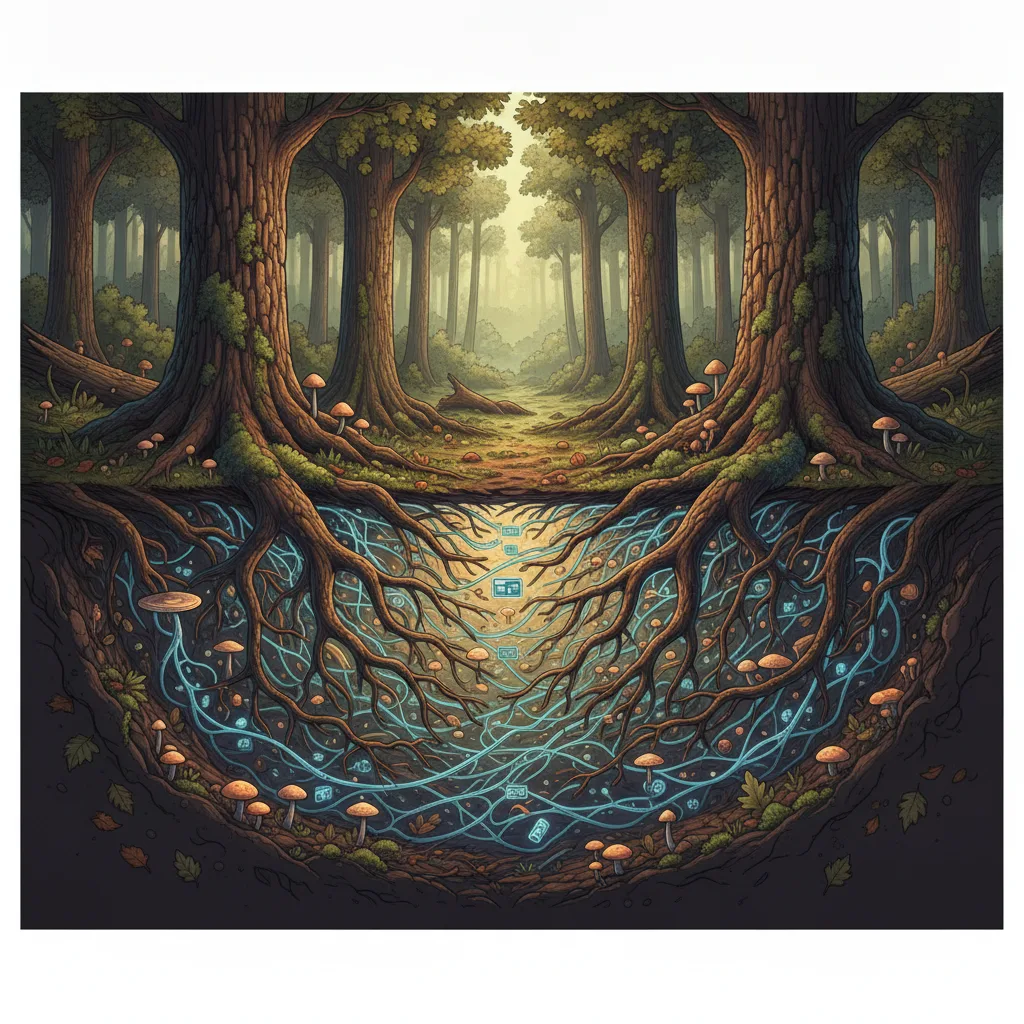
Imagine walking through a forest and feeling that beneath your feet lies a complex communication network, similar to the internet. This is exactly what scientists discovered: forests are interconnected by a vast underground fungal network, known as mycelium.
This network, nicknamed the "Wood Wide Web" (the internet of the forest), allows trees to exchange nutrients, water, and even warning signals about pests or droughts. Fungi act as intermediaries, forming a symbiosis with tree roots (mycorrhizae). Through them, a sick tree can transfer its carbon reserves to healthy ones, or a young fir can receive sugars from a mature fir that "sponsors" it.
Research at Columbia University has mapped this network in coniferous forests, revealing that it can cover square kilometers and connect thousands of trees of different species. It is a collective life support system that challenges our idea of trees as isolated beings, showing that forests function as collaborative superorganisms.
Source: Simard, S. W., et al. (2012). "Mycorrhizal networks: Mechanisms, ecology and modelling". Fungal Biology Reviews.