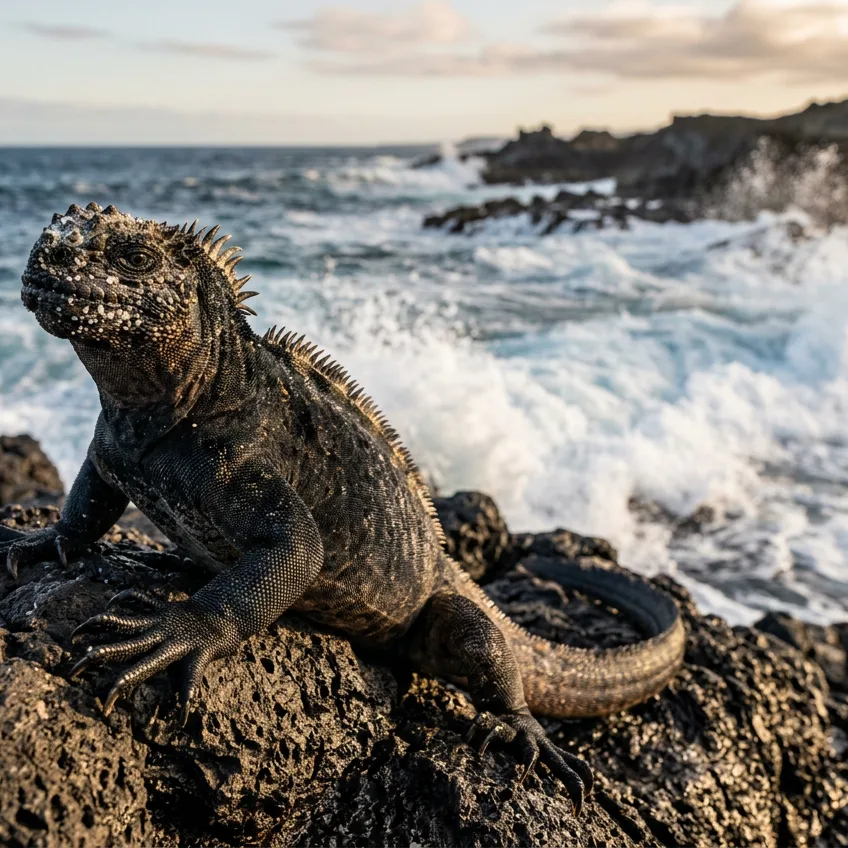
The Galapagos Islands are home to a biological marvel with no equal in the animal kingdom: the marine iguana (Amblyrhynchus cristatus). This reptile, famous for being the only lizard on the planet that dives into the ocean to feed on algae, has an extreme and unusual response to overcome starvation: it shrinks its own bony skeleton when food is scarce.
The phenomenon occurs cyclically due to the El Niño weather pattern. During these episodes, warm currents displace nutrient-rich waters, causing a massive die-off of the red and green algae that make up its regular diet. Faced with the threat of certain death from starvation, adult iguanas reduce their total length by up to 20% in a matter of months.
Research led by biologist Martin Wikelski and published in the journal Nature showed that this reduction is not merely due to fat loss or muscle atrophy: X-rays and direct measurements confirmed that the iguanas actively reabsorb their bone matrix, shortening the actual length of their vertebral column and limbs.
This process offers colossal adaptive advantages:
- Metabolic efficiency: A smaller body requires significantly fewer basal calories to survive.
- Complete reversibility: When cold waters return and underwater algae beds thrive, the animal secretes growth hormones that rebuild bone tissue until it regains its original size.
Throughout its life, the same iguana can shrink and regrow multiple times without suffering permanent deformities.
Source: Nature (Marine iguanas shrink to survive El Niño, Wikelski & Thom, 2000)