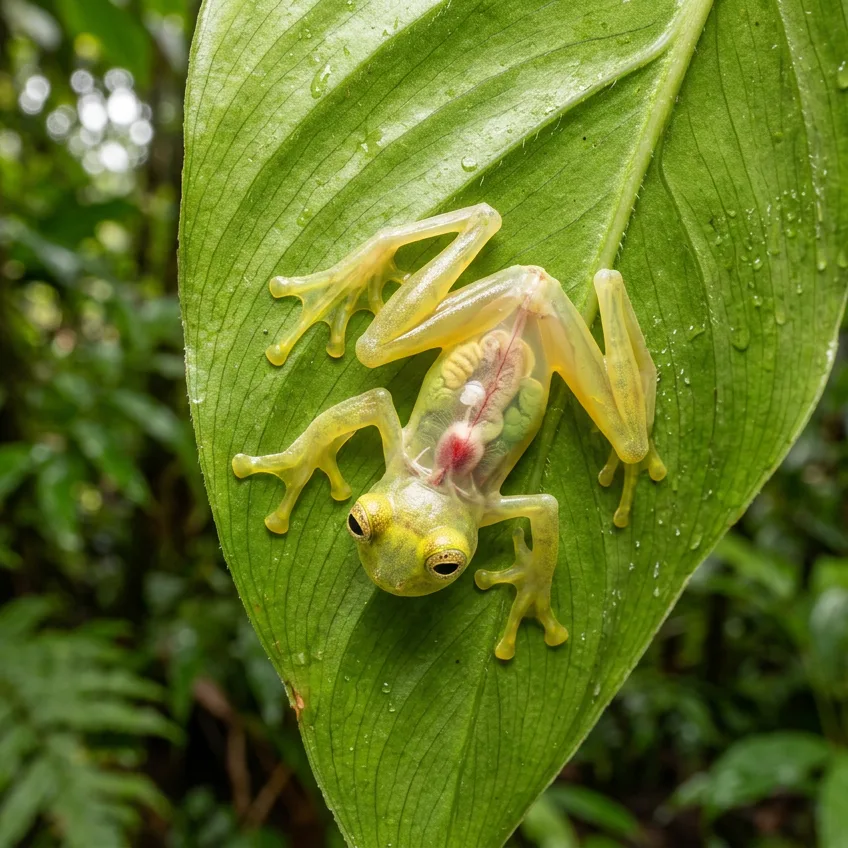
During daylight hours, Fleischmann's glassfrog (Hyalinobatrachium fleischmanni) rests on the underside of tropical leaves. To evade predators, this tiny amphibian relies on extreme camouflage: its flesh, muscles, and bones are translucent. However, science could not explain how it managed to become nearly invisible when blood hemoglobin absorbs light and tints tissues a telltale red.
In 2022, a team of researchers unlocked the mystery in the journal Science using photoacoustic imaging. They discovered that when falling asleep, the frog removes up to 89% of its red blood cells from its bloodstream and packs them inside its liver. This organ, internally coated with reflective guanine crystals that act like mirrors, absorbs the blood mass, doubling in volume while increasing the animal's transparency by 34% to 61%.
What is most astonishing for physiology is how it avoids death:
- Immunity to thrombosis: Such a massive buildup of red blood cells and platelets would trigger instant, lethal blood clots in any other known vertebrate.
- Reactivation in seconds: As soon as the amphibian wakes up or detects a threat, the liver releases the erythrocytes and blood flow is instantly restored without tissue damage.
Studying this evolutionary marvel not only helps decipher the limits of animal camouflage, but also provides valuable clues for biomedicine to develop new human anticoagulant drugs capable of preventing thrombosis and strokes without bleeding side effects.
Source: Science (Taboada et al., 2022 - 'Glassfrogs conceal erythrocytes in the liver to maintain transparency')