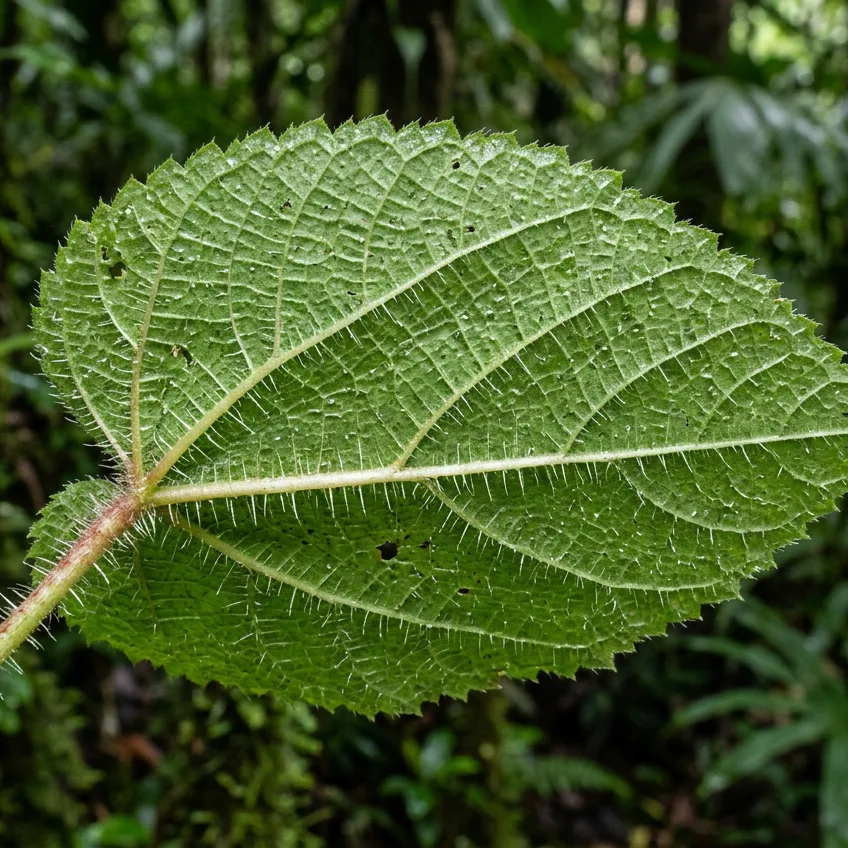
In the rainforests of Queensland, in northeastern Australia, lives a seemingly harmless shrub known as the Gympie-Gympie (Dendrocnide moroides). Far from being limited to simple irritation like common nettles, contact with its broad, heart-shaped leaves can trigger one of the most prolonged and devastating physical torments documented in botany.
The secret to its lethal defense lies in its covering: stems and leaves are carpeted with millions of hollow trichomes made of silicon dioxide, genuine hypodermic needles of microscopic mineral glass. At the slightest touch, the tips break off inside human skin and release an extremely stable chemical cocktail. Researchers from the University of Queensland discovered in 2020 that its venom contains an unprecedented class of miniproteins dubbed gympietides, whose three-dimensional structure folds identically to the toxins of spiders or cone snails, permanently hijacking the sodium channels of pain-sensing neurons.
Because the silica microneedles are insoluble and do not degrade easily in subcutaneous tissue, they remain trapped under the dermis. This causes the excruciating pain to flare up intensely for weeks or months whenever the affected area is washed with cold water or undergoes pressure changes. The chemical armor of the Gympie-Gympie is so persistent that dried herbarium specimens collected over a century ago still retain their full ability to pierce with their hairs and discharge their venom.
Source: Science Advances / University of Queensland