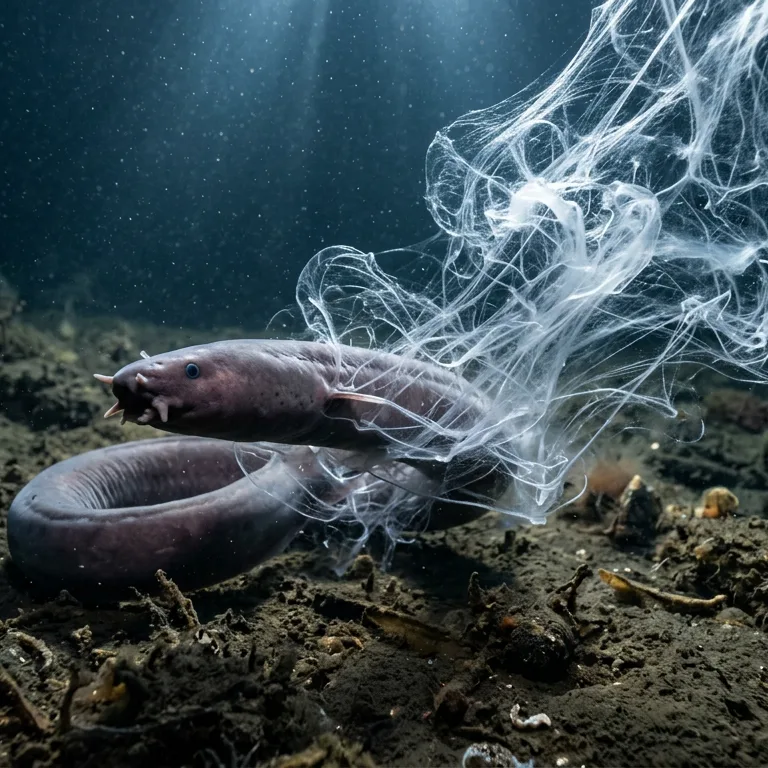
In the ocean depths lives the hagfish (order Myxiniformes), a primitive jawless scavenger that possesses one of the most lethal and sophisticated defensive tactics in the animal kingdom: turning the surrounding water into an impenetrable gelatinous mass in a fraction of a second.
When a predator—such as a shark or a large bony fish—attempts to bite it, the hagfish secretes just a few milligrams of milky fluid from dozens of specialized glands along its flanks. In less than 400 milliseconds, this tiny discharge reacts with seawater and expands to multiply its volume more than 10,000 times, turning entire liters of water into a tenacious hydrogel.
The key to this instantaneous reaction lies in two prodigious cellular components:
- Thread skeins: Cells that package microscopic keratin threads up to 15 centimeters in length, coiled so neatly that they unspool in water without ever tangling.
- Mucin vesicles: Capsules that absorb water and burst upon contact with marine salts, trapping water molecules within the fibrous network.
The result immediately chokes the mouth and gill slits of the attacker, suffocating it and forcing it to spit out its prey. To avoid getting trapped in its own snare, the hagfish performs an astonishing maneuver: it ties a sliding knot with its body and slides it from head to tail, scraping off the viscous mass before escaping unharmed.
Source: Current Biology / Royal Society Open Science (biomechanical studies of Myxine glutinosa hydrogel)