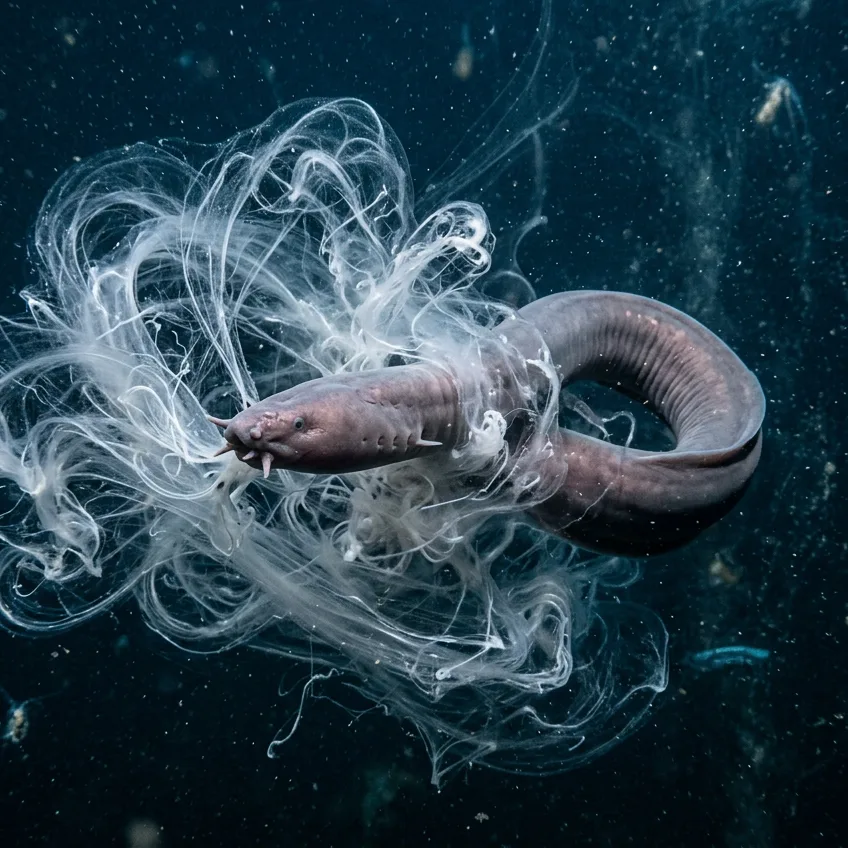
In the ocean depths lives the hagfish (order Myxiniformes), one of the most archaic vertebrate creatures on the planet. Lacking jaws, an articulated spine, or scales, it has survived for more than 300 million years thanks to a sophisticated biological shield: the production of one of the most extraordinary mechanical substances in nature.
When a predator, such as a shark, tries to bite it, the hagfish activates about one hundred specialized glands along its flanks. These expel just a few milligrams of a biological concentrate composed of two elements: mucin cells and thread cells. Each of the latter contains an elastic keratin protein filament fifteen centimeters long, coiled almost quantically into a tiny microscopic sphere.
Upon contact with saltwater and the turbulence of the attack, the marvel occurs:
- Ballistic unspooling: The skeins of thread unravel in less than 400 milliseconds, surpassing spider silk in both speed and strength.
- Volumetric expansion: The filaments trap surrounding water, expanding the volume of the secretion up to ten thousand times in a fraction of a second.
- Suffocating blockage: The mixture instantly generates nearly a liter of viscous hydrogel that immediately seals the attacker's gills, forcing it to spit out the hagfish to avoid suffocation.
To avoid suffocating in its own slime, the hagfish relies on its flexible anatomy: it can tie its body into a sliding knot that travels from head to tail, scraping off the gelatinous mass before escaping unharmed.
Source: Current Biology / Nature Communications (Biomaterials and Hagfish Slime Mechanics)