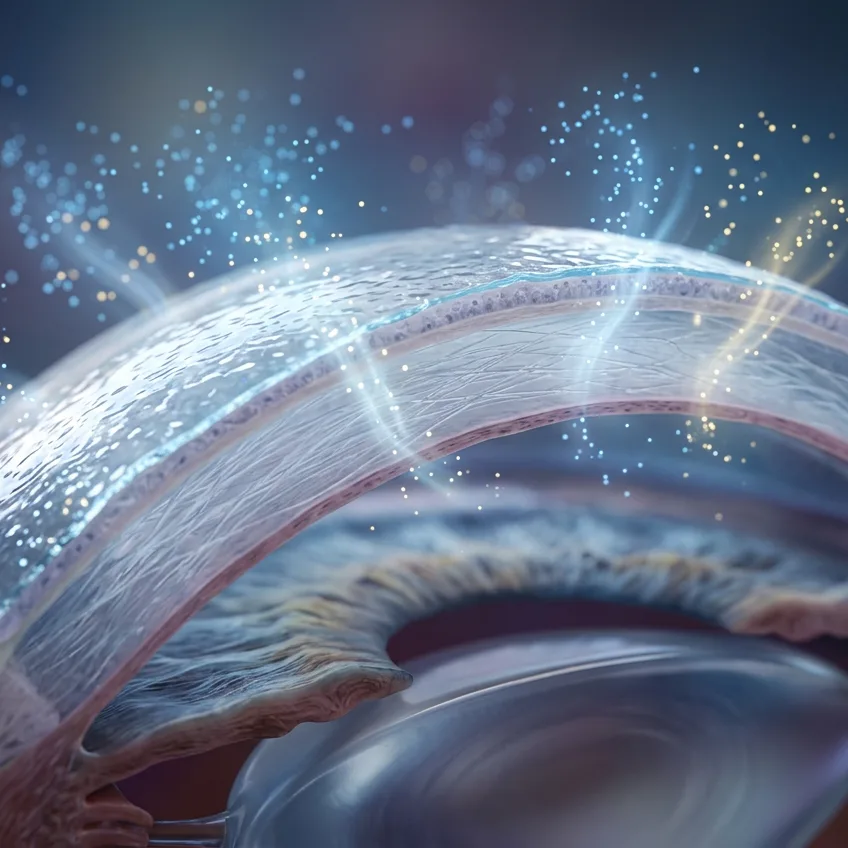
For light to reach the retina unimpeded and allow us to see the world clearly, the human cornea must be a perfectly transparent biological lens. However, keeping its living cell layers alive poses a serious physiological dilemma: any network of blood capillaries would scatter light and blur our vision. Evolution's solution was to completely do away with blood vessels, making the cornea the only living tissue in our body that obtains almost all of its oxygen directly from the outside air.
This gas exchange occurs through the tear film. Every time we blink, a microscopic layer of tears moistens the eye's surface, dissolving atmospheric oxygen and allowing it to diffuse passively into the corneal cells. Meanwhile, glucose and other essential nutrients reach it from behind via the aqueous humor, the clear fluid filling the eye's anterior chamber.
At night, when closed eyelids cut off contact with the air, the eye relies on an ingenious backup mechanism: tiny vessels in the palpebral conjunctiva (the inner eyelid) transfer oxygen to trapped tears, although levels drop by about 60 % compared to waking hours.
This fascinating biological design explains key aspects of eye care:
- Breathable contact lenses: Prolonged wear of lenses with low gas permeability suffocates the cornea, causing edema and inflammation.
- Corneal neovascularization: If oxygen deprivation becomes chronic, the body tries to rescue the tissue by sprouting abnormal blood vessels toward the center of the eye, irreversibly impairing vision.
Source: American Academy of Ophthalmology (AAO) / Nature Reviews Ophthalmology