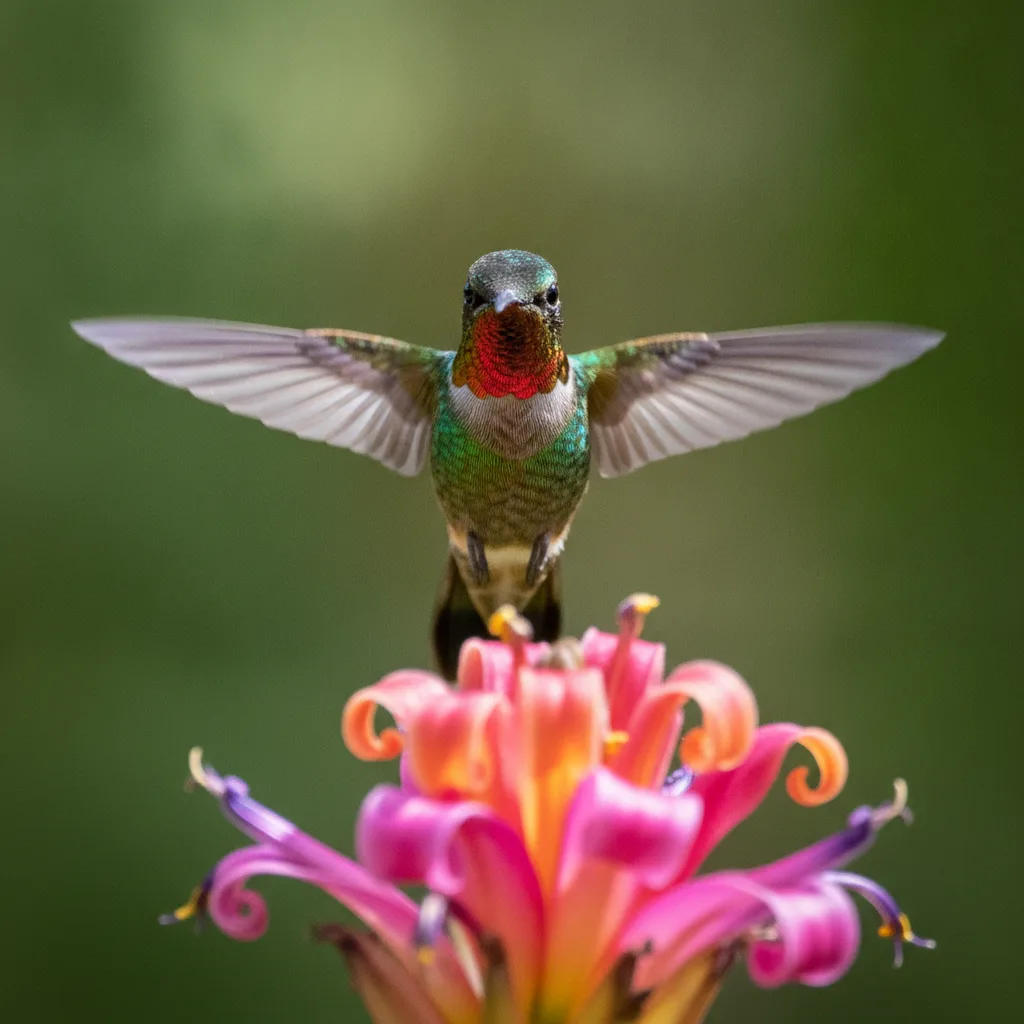
Hummingbirds, also known as picaflores, are true jewels of nature, famous for their vibrant colors and, above all, their unique flight abilities. Unlike any other bird species on the planet, hummingbirds possess the extraordinary capacity to fly backward and hover motionless in midair, qualities that have earned them the nickname "natural helicopters."
This aerodynamic feat is possible thanks to a series of incredible physiological adaptations. Their wings not only beat at dizzying speeds, up to 80 times per second in some species, but can also rotate 180 degrees at the shoulder joint. This circular motion, similar to a helicopter's propeller, allows them to generate lift on both the upstroke and downstroke, thus controlling their position with pinpoint precision.
To sustain this prodigious flight, hummingbirds have an extremely fast metabolism and a heart that can beat up to 1,200 times per minute. Their pectoral muscles, which account for nearly one third of their body mass, are extraordinarily powerful and designed for extreme endurance. They get this energy from floral nectar, which they must feed on constantly to avoid starvation.
The ability to hover and fly backward is crucial for their survival, as it allows them to access flower nectar in ways other pollinators cannot, inserting their long bills at impossible angles and extracting their food before quickly darting away. They are true engineers of nature, defying our expectations of what is possible in the avian world.
Source: National Geographic, Audubon Society, ScienceDirect



