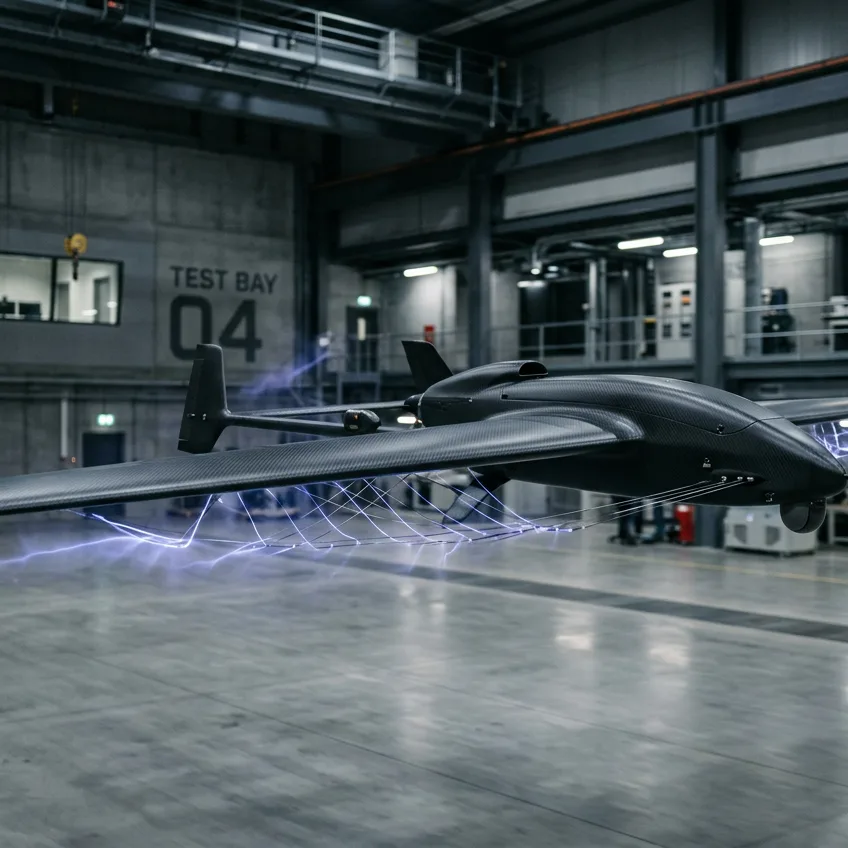
Since the Wright brothers, flying seemed inevitably to require spinning propellers, turbines, or jet engines burning fuel. However, in 2018, a team of engineers from the Massachusetts Institute of Technology (MIT) led by Professor Steven Barrett challenged over a century of aeronautical engineering by flying the first airplane in history without a single moving part or conventional engine.
The secret of this aircraft with a 5-meter wingspan and weighing just 2.45 kilograms lies in electroaerodynamic propulsion, popularly known as ionic wind. Instead of pushing mass with mechanical blades, the vehicle uses a battery connected to a converter capable of boosting electricity to 40,000 volts:
- Air ionization: At the front, thin wires charged to extremely high voltage strip electrons from surrounding nitrogen molecules, turning them into positive ions.
- Invisible acceleration: These ions are drawn at high speed toward negatively charged receiving electrodes located at the back of the wing.
- Collision thrust: Along this rapid journey, the ions collide with millions of neutral air molecules, transferring their momentum and creating a steady stream of wind that pushes the plane forward.
In its first test flights inside a campus gymnasium, the drone traveled 60 meters with complete smoothness and a nearly ghostly silence, generating no direct emissions. Although the technology still needs to solve energy density challenges for large-scale commercial aircraft, this milestone paves the way for future ultralight and undetectable delivery drones operating in cities without disrupting noise peace.
Source: Nature (Barrett et al., 2018) - 'Flight of an aeroplaneless aeroplane with solid-state propulsion'