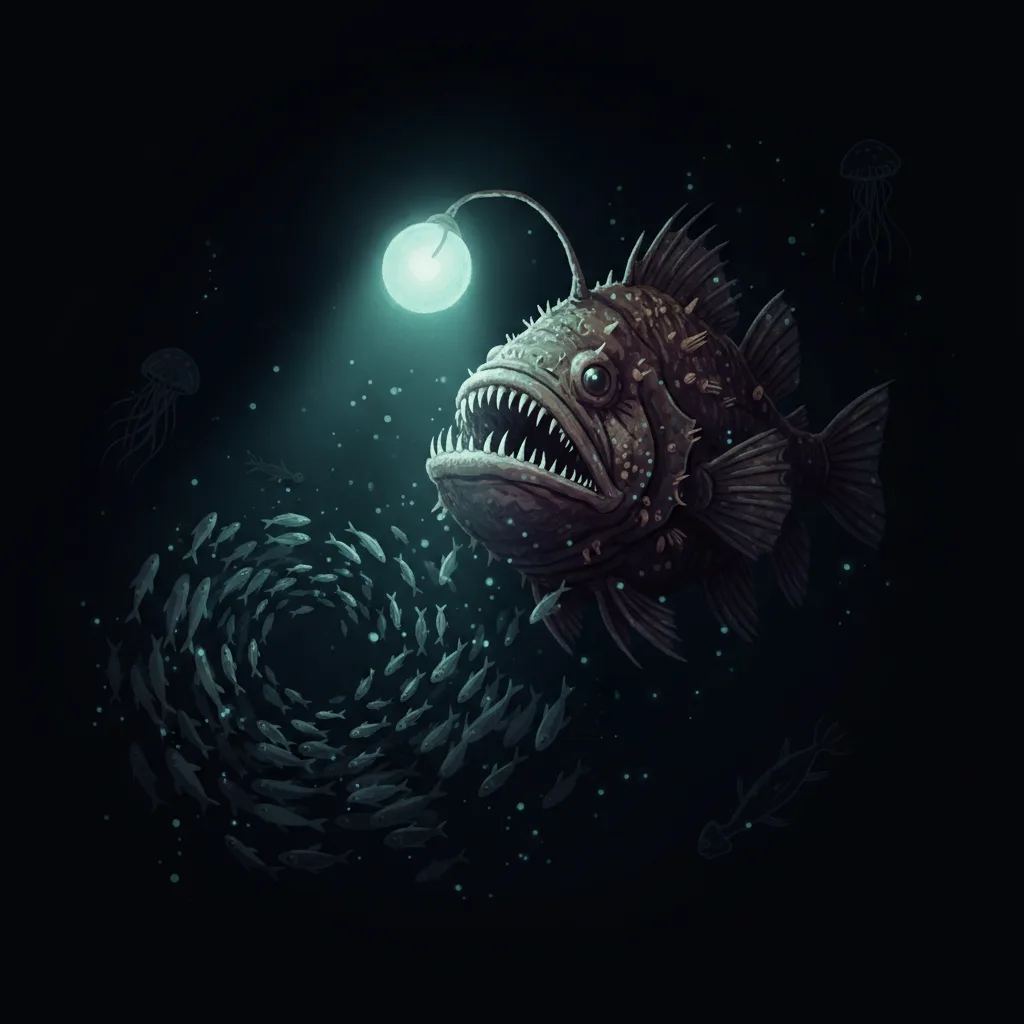
In the immense, dark oceanic depths where sunlight does not dare penetrate lives one of the strangest and most fascinating creatures on the planet: the black seadevil or anglerfish. This abyssal predator has developed a survival and reproduction strategy that defies the imagination, becoming a living lantern in the eternal darkness.
Its most distinctive feature is a bioluminescent organ, known as a photophore, that projects from its head like a fishing rod. This "lantern" is not intrinsic to the fish; it is actually home to millions of symbiotic bacteria that emit a bright light. The anglerfish uses this light for two vital purposes: attracting prey fooled by the lure in the dark, and finding a mate in a vast, lonely ecosystem.
Yet the uniqueness of the anglerfish does not end there. Its reproductive process is equally astonishing. Males are considerably smaller than females and, once they find a mate, attach permanently to her body. The male fuses with the female, and their circulatory systems join, turning him into a "parasite" who receives nutrients from her. In exchange, the female gets a constant supply of sperm for reproduction, ensuring the continuity of the species in an environment where finding a mate is a rare luxury. This extreme adaptation highlights nature's ingenuity in overcoming the most formidable challenges.
Source: National Geographic, Smithsonian Ocean