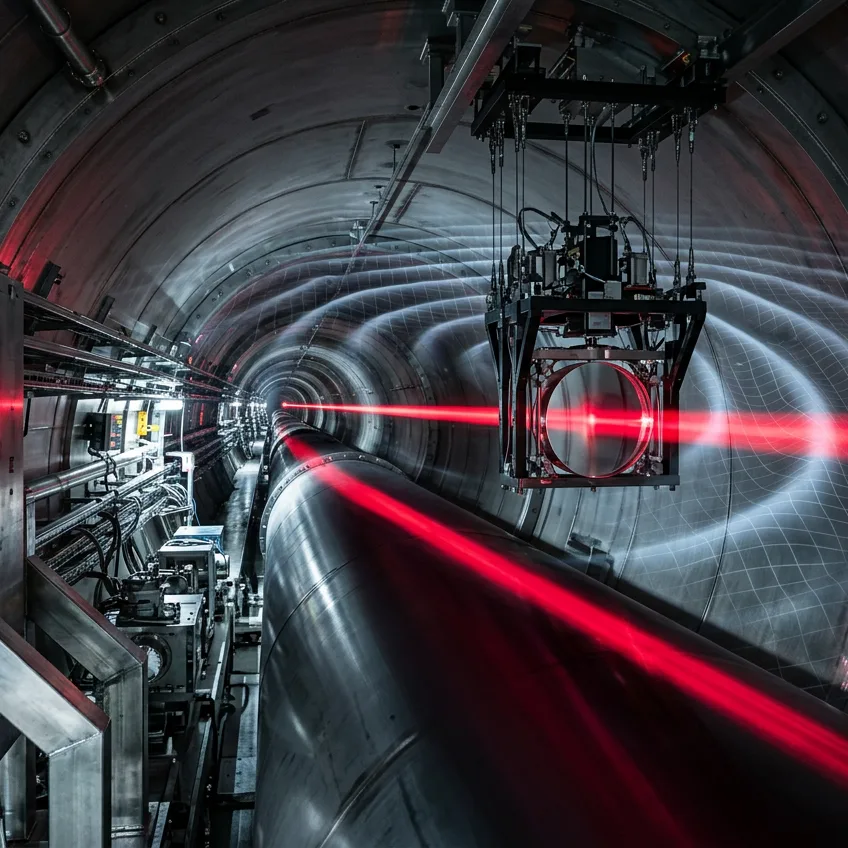
Detecting the passage of a gravitational wave caused by the collision of two black holes more than one billion light-years away requires precision bordering on the impossible. When these cosmic disturbances pass through Earth, they distort the very fabric of space-time, but they do so on an infinitesimal scale. To record this phenomenon, the Laser Interferometer Gravitational-Wave Observatory (LIGO) built one of the most sensitive machines ever conceived.
LIGO consists of two twin facilities in Washington and Louisiana, separated by 3,002 kilometers. Each has two four-kilometer vacuum tunnels arranged at right angles. Inside, an ultra-clean laser beam is split, bounces hundreds of times between ultra-pure mirrors suspended on fused silica, and recombines. If a gravitational wave crosses Earth, it stretches one arm of the interferometer and compresses the other in an alternating pattern.
The magnitude of the measurement is almost inconceivable:
- The detected change in length is around 10-19 meters, a figure ten thousand times smaller than the diameter of a proton.
- In proportional terms, this precision is equivalent to measuring the distance between Earth and the star Proxima Centauri (more than four light-years away) with a margin of error smaller than the thickness of a human hair.
To prevent thermal fluctuations or the pressure of photons themselves from masking the signal, scientists inject squeezed quantum light (squeezed light). This pioneering technique pushes past the conventional limits of Heisenberg's uncertainty principle, dampening noise in the phase of light to clearly hear the most distant cataclysms of the cosmos.
Source: Caltech / MIT - LIGO Laboratory (Physical Review Letters, 2016)