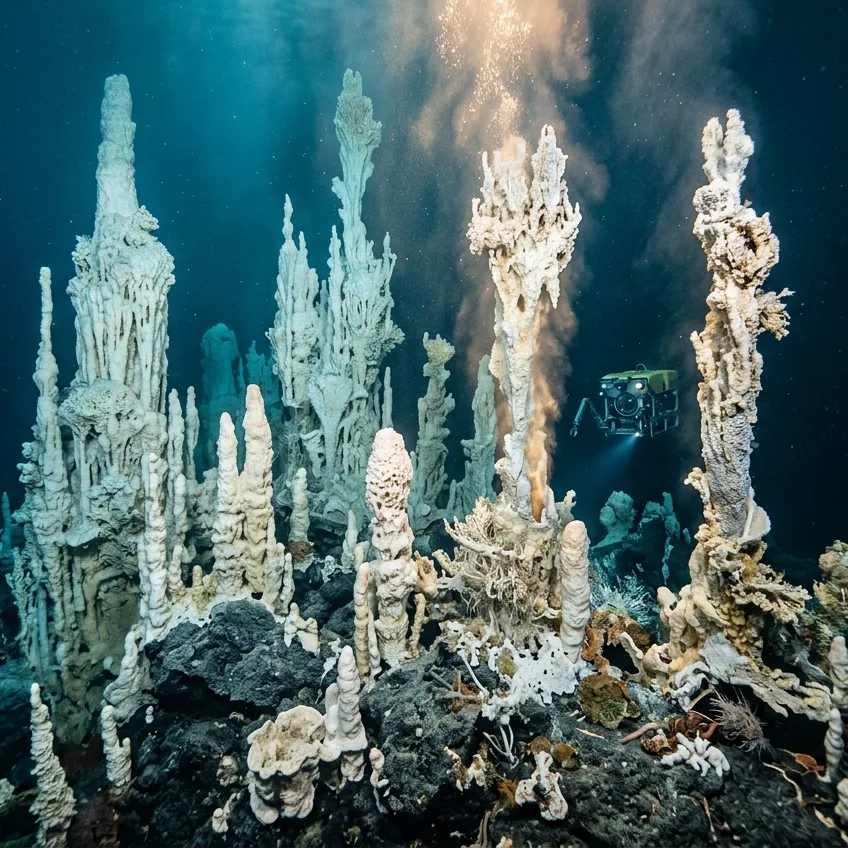
In December 2000, an oceanographic expedition along the Mid-Atlantic Ridge stumbled upon a landscape that looked plucked from another planet: the Lost City hydrothermal field (Lost City). At a depth of about 750 meters, along the flank of the underwater Atlantis Massif, giant spires and towers of white limestone rise up to sixty meters high, the equivalent of a twenty-story building.
Unlike the well-known "black smokers," which spew dark fluids at 400 °C driven by volcanic magma chambers, the chimneys of the Lost City function without nearby lava. Their geological engine is a geochemical process called serpentinization:
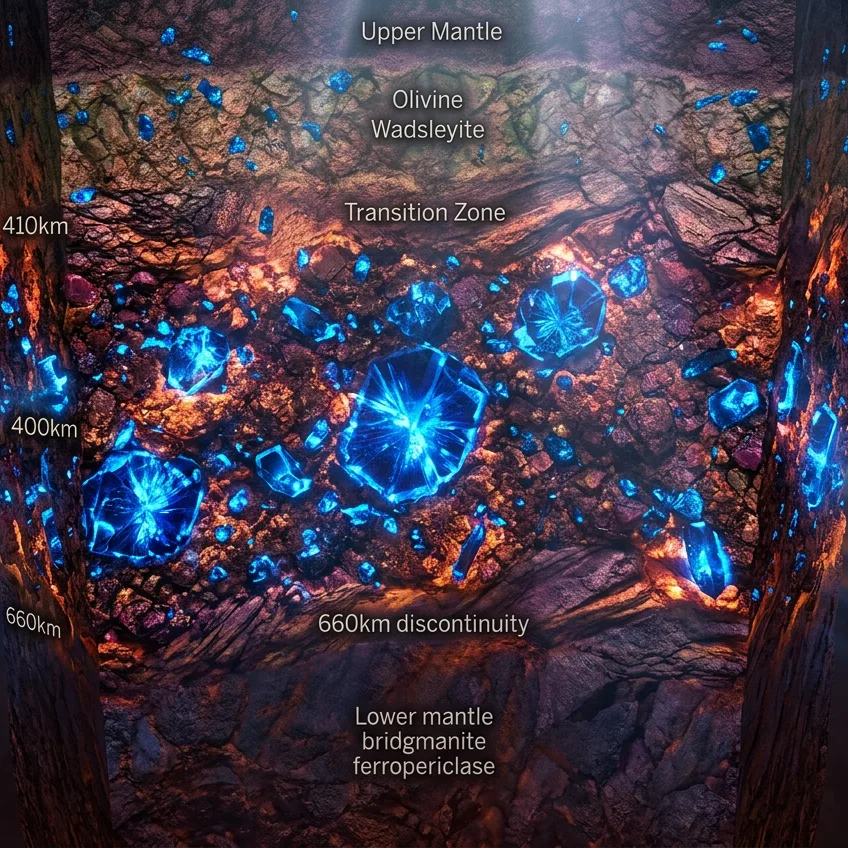
- Reaction with the mantle: Ocean water infiltrates through deep tectonic faults and comes into direct contact with peridotite, an olivine-rich igneous rock from the upper mantle.
- Exothermic heat and extreme alkalinity: When hydrated, mantle minerals transform into serpentine, releasing heat spontaneously. This phenomenon warms the fluids between 40 °C and 90 °C and drives their pH to highly alkaline values (between 9 and 11).
- Precipitation of carbonates: Upon rising and mixing with cold seawater, the dissolved calcium immediately crystallizes into calcite and aragonite, erecting these colossal columns that have been growing uninterrupted for more than 120,000 years.
This system not only astonished geologists by proving that sea floors can be heated without volcanism, but also because it generates large volumes of hydrogen and methane through purely inorganic means. For this reason, the scientific community believes that reactions identical to those at the Lost City may have served as the geochemical cradle for early life and could be happening right now beneath the icy crust of moons like Enceladus or Europa.
Source: National Science Foundation / Woods Hole Oceanographic Institution (WHOI)