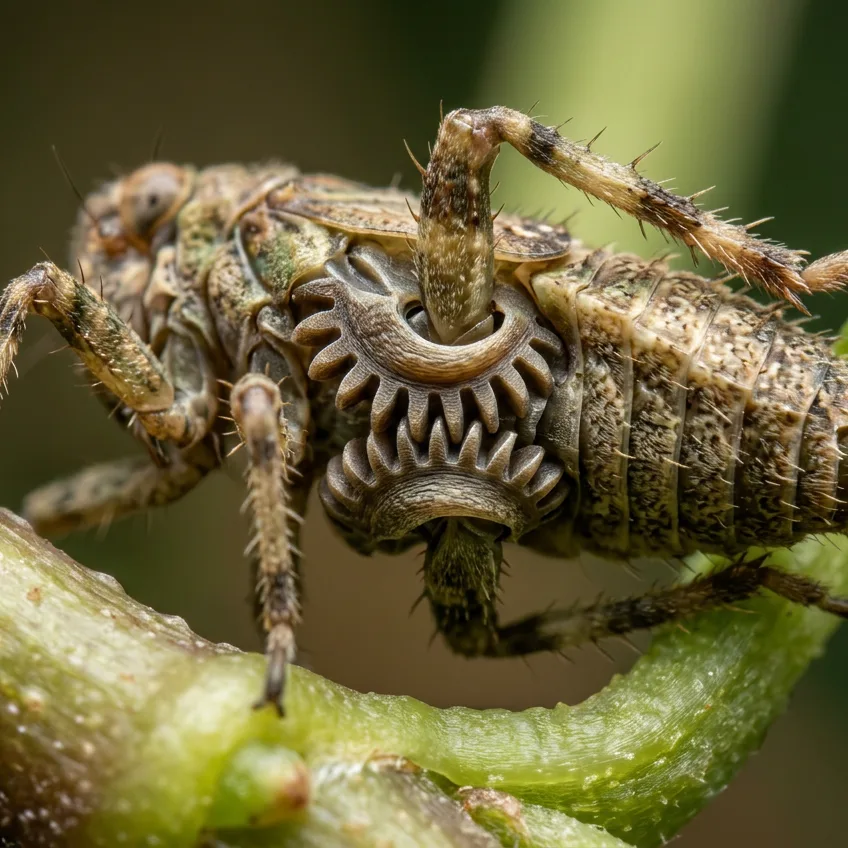
For centuries it was believed that toothed gears were an exclusively human invention. However, in 2013, researchers Malcolm Burrows and Gregory Sutton from the University of Cambridge revealed a fascinating discovery: the nymph of the common planthopper (Issus coleoptratus), an insect measuring just a few millimeters, possesses a real mechanical gearbox on its hind legs.
To escape predators, this tiny arthropod executes explosive jumps at speeds of almost four meters per second, experiencing accelerations of up to 400 g. At that scale, if one leg were to trigger just a few millionths of a second before the other, the insect would spin in an uncontrollable flat spin. Nerve impulses are too slow to guarantee such extreme coordination, so evolution solved the problem by bypassing the brain and turning to pure physics.
At the base of the hind legs (the trochanters), the nymph features a curved strip of 10 to 12 microscopic teeth measuring between 15 and 30 micrometers in height. When preparing to jump, the teeth on both legs interlock precisely, so that the movement of one limb mechanically drags the other, synchronizing the push in less than 30 microseconds.
Most astonishingly, this system is only present during juvenile stages. Upon reaching adulthood after its final molt, the insect loses the gears and switches to a friction mechanism; scientists suggest this is because, if a tooth breaks in the adult phase, the creature would be crippled for life since it cannot molt its exoskeleton to regenerate it.
Source: Science (Burrows & Sutton, 2013 - 'Interacting Gears Synchronize Propulsive Leg Movements in a Jumping Insect')