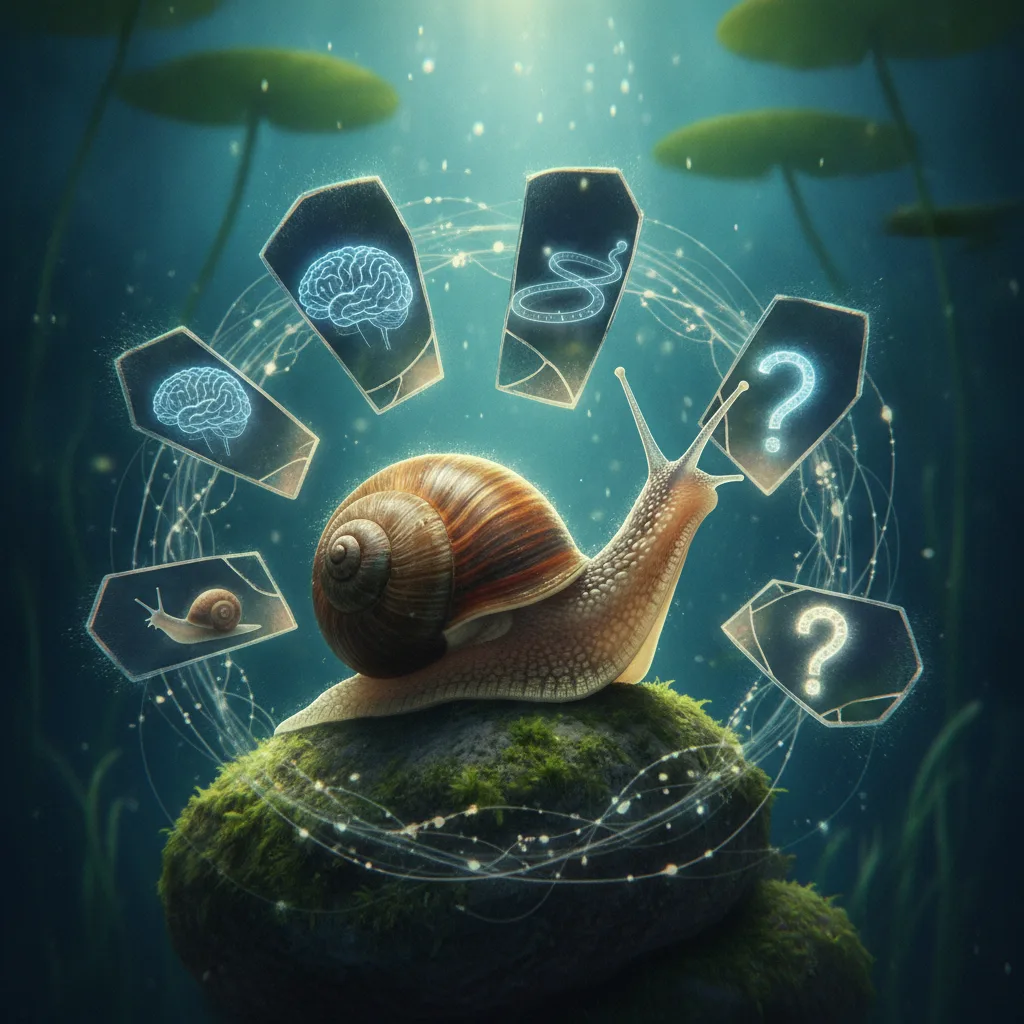
The great pond snail (Lymnaea stagnalis) possesses an ability that seems straight out of science fiction: it can learn and retain memories, despite lacking a centralized brain. Its nervous system is distributed across three ganglia containing just 20,000 neurons, a tiny fraction of the 86,000 million found in a human brain.
Research from the University of Calgary showed that these snails can learn to avoid an unpleasant stimulus (such as a mild electric current) by associating it with a specific odor. The astonishing part is that, after a training period, they can retain this learning for at least 30 days, a considerable duration given their life expectancy of 2 to 5 years.
This phenomenon challenges the classic view that memory requires complex brain structures like the hippocampus. It suggests that the capacity to store information may be a more fundamental and distributed property of nervous systems, even the simplest ones. These findings have profound implications for neuroscience and the search for the basic mechanisms of cognition and consciousness across the animal scale.
Source: Study by the University of Calgary published in 'Current Biology' (2019).