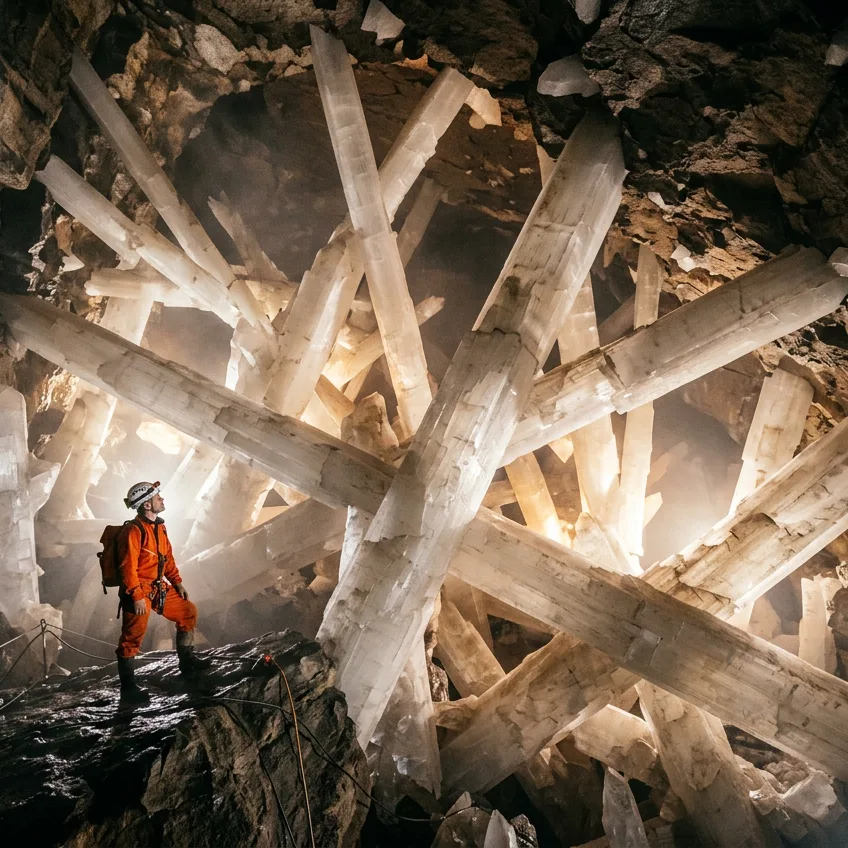
At a depth of 300 meters beneath the Sierra de Naica, in the Mexican state of Chihuahua, lies one of the planet's most extreme geological wonders: the Cave of the Crystals. Discovered accidentally in 2000 by two miners digging a drainage tunnel, this cavern houses gigantic prisms of selenite (a translucent variety of gypsum) reaching up to 11.4 meters in length and weighing over 50 tons.
The genesis of these colossal mineral beams required an unusual combination of time, isolation, and thermodynamic stability:
- The magma chamber: Several kilometers deep, an intrusion of residual magma kept groundwater at high temperatures for hundreds of thousands of years.
- Constant saturation: The liquid was filled with anhydrite (calcium sulfate without water). As the temperature dropped very slowly below 58 °C, the anhydrite became unstable and began to dissolve, transferring its molecules to gypsum crystals.
- Imperceptible growth: In this millimeter-stable thermal environment, the crystals grew molecule by molecule for more than 500,000 years without external disturbances.
The environment inside the cave is lethal to humans. With temperatures up to 58 °C and relative humidity near 100%, human lungs act as the coldest surface in the room, causing vapor to condense inside the respiratory system. Scientists could only enter equipped with ice-cooling suits and special respirators, limiting their visits to a maximum of fifteen minutes.
In 2015, the artificial pumping that drained water from the mine stopped, allowing the cave to naturally resubmerge in its original aquifer, thereby preserving this unique geological laboratory.
Source: García-Ruiz, J. M., et al. (2007). Formation of natural gypsum megacrystals in Naica, Mexico. Geology, 35(4), 327-330.