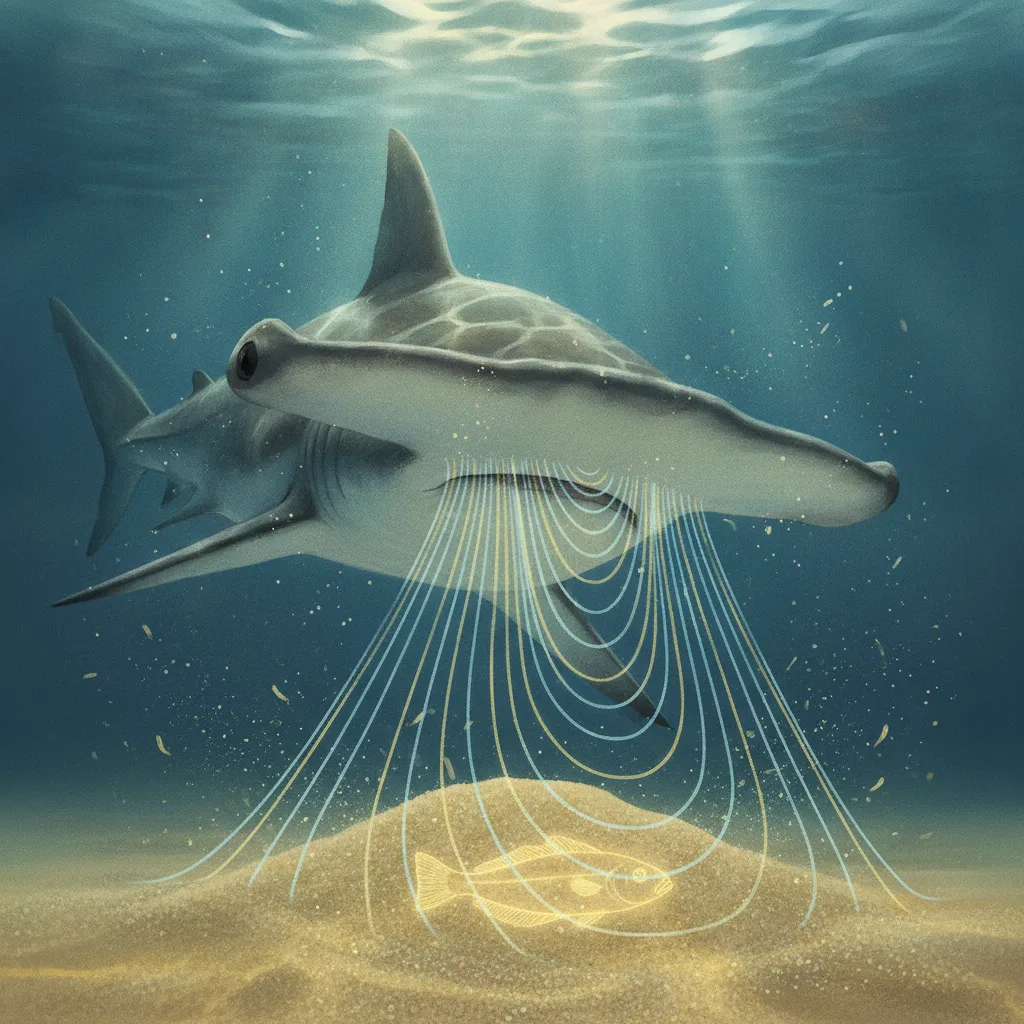
Imagine being able to "see" the muscular activity of a fish hidden beneath the sand, without the need for light or direct contact. This superpower is a reality for sharks and rays, true masters of electroreception, thanks to their impressive ampullae of Lorenzini.
These unique sensory organs are a network of pores and canals filled with a conductive gel that spreads across the heads of these animals, particularly visible as small dark dots. Each pore connects to highly sensitive nerve cells that can detect even the tiniest electrical fluctuations generated by muscle contractions, heartbeats, or the simple breathing of other living organisms. The sensitivity is astounding, registering voltage changes as small as one billionth of a volt, far beyond the capability of any current human sensor!
This ability gives them an unmatched predatory advantage, especially in environments where vision is limited. A shark can swim over a seabed, "listening" to the tiny electrical signals of a camouflaged flounder or a buried ray, and launch a precise strike without seeing its prey. It is not only vital for hunting; they are also believed to use this sense for navigation, orienting themselves by Earth's magnetic field, and even for detecting changes in water salinity or temperature, or communicating with other members of their species, especially during courtship or territorial displays.
The ampullae of Lorenzini are an amazing testament to evolution, showing how nature has equipped some of its creatures with sensory tools that far exceed our own capabilities. This electroreception allows them to dominate their ecosystems in ways we are just beginning to understand, revealing a biological "sixth sense" that redefines perception of the world.
Source: National Geographic, ScienceDaily, NOAA Fisheries