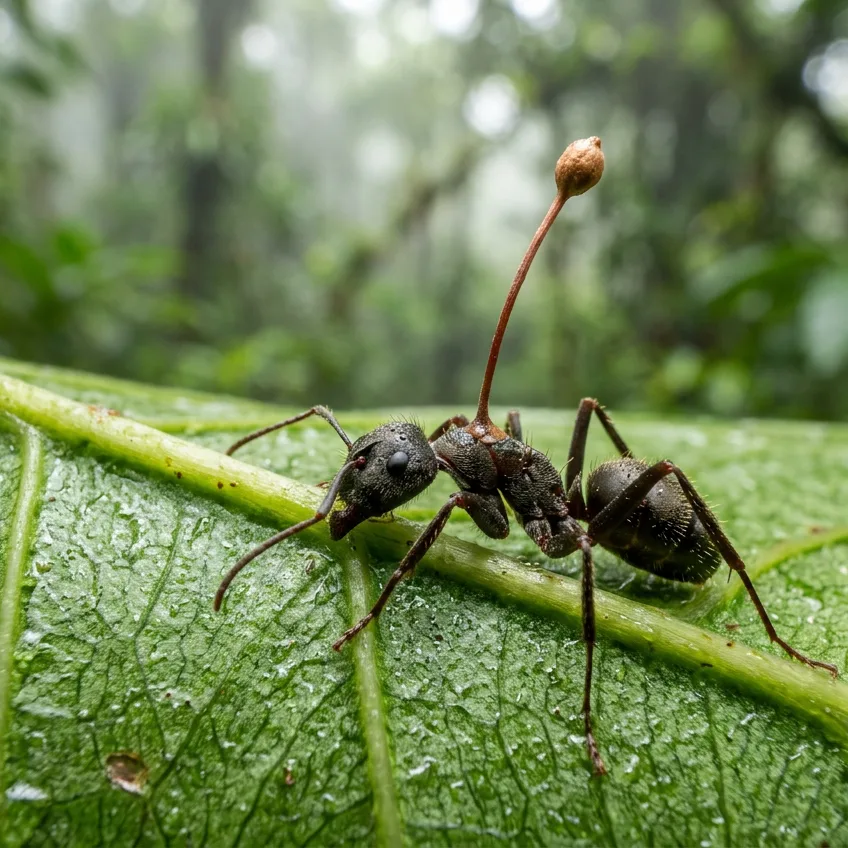
For decades, science assumed that the parasitic fungus Ophiocordyceps unilateralis turned carpenter ants into zombies by directly hijacking their brains using chemical compounds. However, a groundbreaking study published in 2017 by Pennsylvania State University revealed a much more unsettling reality: the fungus leaves the insect's brain virtually untouched and takes physical control by operating its limbs from inside its muscles.
Using three-dimensional electron microscopy and machine learning algorithms, researchers reconstructed the cellular progression of the pathogen. They discovered that fungal cells proliferate throughout the ant's body until they fuse together, creating an interconnected biological network that penetrates and surrounds muscle bundles. This network communicates through its own biochemical signals to force the ant's muscle fibers to contract involuntarily.
This mechanism turns the insect into a true biological puppet. The parasite commands the ant's body and forces it to perform a series of precise behaviors:
- Abandon the safety of the colony and climb a plant to exactly twenty-five centimeters above the ground, where humidity and temperature are optimal for the fungus.
- Clamp its mandibles onto the underside of a leaf with an irreversible spasm known as the 'death grip.'
Once immobilized, the fungus finally consumes the ant's internal organs and sprouts a fungal stalk through its head to shower spores down on the rest of the anthill.
Source: Proceedings of the National Academy of Sciences (PNAS)