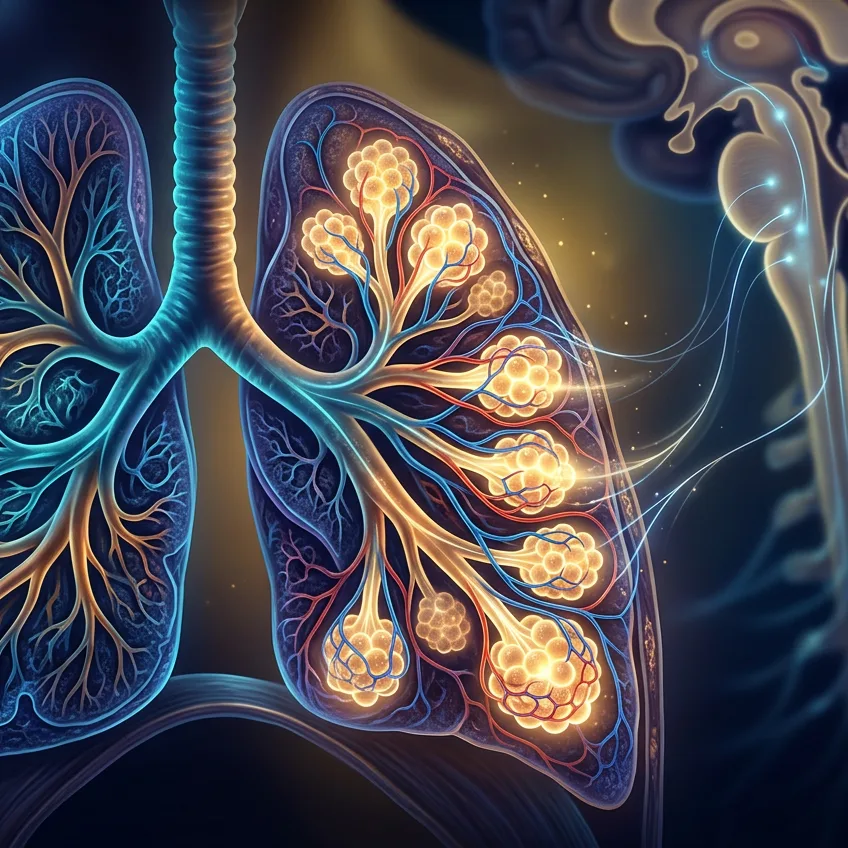
Throughout the day, you sigh completely involuntarily about twelve times per hour, a steady pace of once every five minutes. Far from being a mere expression of sadness, boredom, or psychological relief, this phenomenon is a mechanical survival mechanism controlled by a tiny group of barely two hundred neurons located in the pre-Bötzinger complex, the breathing control center in the brainstem.
Researchers from Stanford and UCLA discovered in 2016 that this microcircuit acts as an emergency biological switch. Human lungs house nearly 500 million alveoli, tiny elastic sacs where gas exchange occurs. With normal breathing at rest, many alveoli gradually lose surface tension and progressively collapse on themselves in a process called microatelectasis, which reduces the surface area available to absorb oxygen.
When internal sensors detect this decline, the brain issues the command to perform a physiological sigh: a standard first inhalation immediately followed by a shorter, shallower second breath, before releasing the air in a slow exhalation. This second inhalation generates an overpressure that 'unsticks' and suddenly reinflates the collapsed alveoli, instantly restoring lung capacity.
Beyond protecting lung structure, the physiological sigh directly impacts well-being: the prolonged exhalation activates the vagus nerve and stimulates the parasympathetic system, which immediately lowers heart rate and makes this maneuver the body's fastest natural anxiety reliever.
Source: Nature (2016) - 'The peptidergic control circuit for sighing', Stanford University School of Medicine & UCLA.