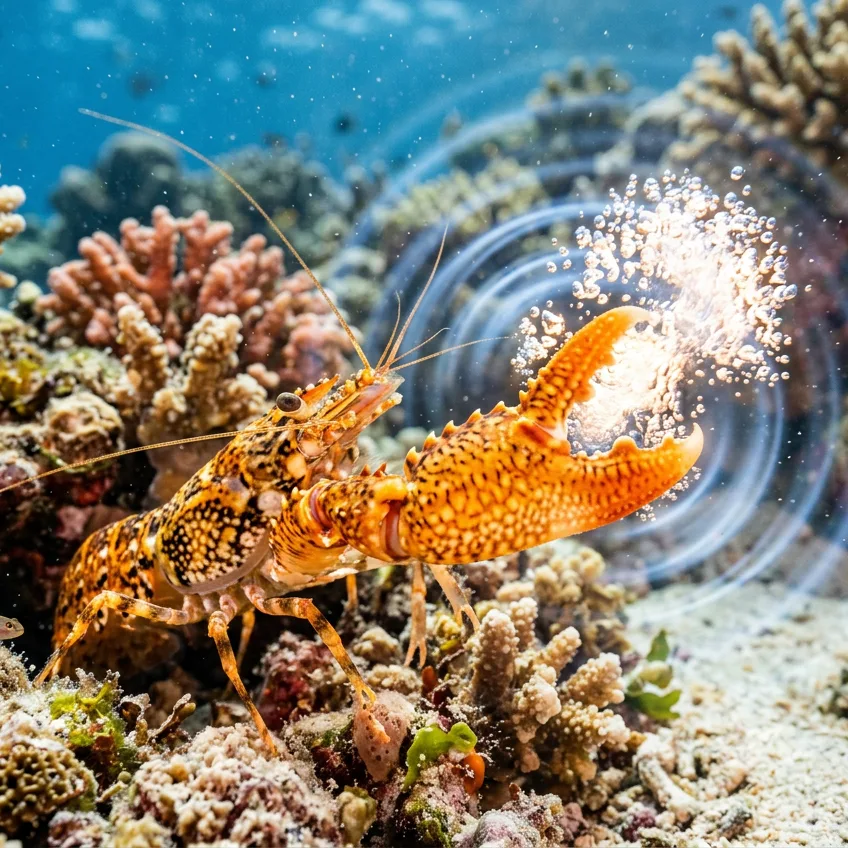
Beneath coastal waters lives a creature barely five centimeters long capable of unleashing one of the most extreme physical phenomena on the planet: the pistol shrimp (family Alpheidae). Unlike other marine predators, it does not hunt by biting or tearing its prey; instead, it uses an oversized claw transformed into a lethal sonic weapon.
When the shrimp violently snaps its specialized claw, it shoots a jet of water at over 100 km/h. The fluid speed is so immense that local pressure drops drastically below vapor pressure, generating a tiny cavitation bubble. After traveling a few millimeters and encountering higher pressure water, the bubble collapses catastrophically in a fraction of a microsecond.
This collapse triggers astonishing consequences:
- Extreme heat: Inside the bubble, compressed gases briefly reach temperatures of up to 4,700 °C, nearing the temperature of the sun's surface.
- Sonoluminescence: The implosion produces a flash of light imperceptible to the human eye without specialized instruments.
- Deafening shockwave: It generates an acoustic blast exceeding 210 decibels, louder than a gunshot or a rocket launch.
The acoustic impact instantly stuns or kills nearby small fish and crabs. In fact, colonies of these crustaceans create such a collective underwater roar that they have historically jammed military sonar signals from naval submarines.
Source: Science (Detlef Lohse et al., 'Snapping shrimp make flash of light', 2001)