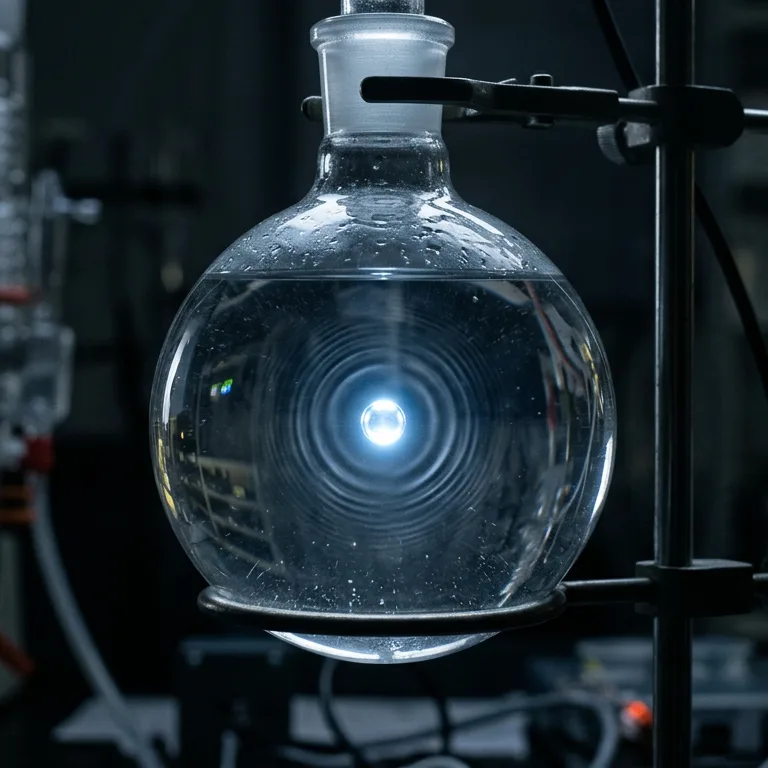
Just two degrees above absolute zero (-270.98 °C), the helium-4 isotope crosses a physical boundary known as the lambda point (2.17 Kelvin). At that exact instant, the laws of quantum mechanics leave the atomic scale and become visible to the naked eye in an extraordinary state: superfluid helium (or Helium II), a liquid whose viscosity drops exactly to zero.
Lacking internal friction, this fluid defies the usual laws of hydrodynamics through the so-called Rollin film, identified by physicist Bernard Rollin at the University of Oxford during the 1930s. Driven by van der Waals attractive forces between the liquid and the container's solid walls, the helium forms an invisible film barely 30 nanometers thick (about 100 atoms) that spontaneously climbs vertical walls.
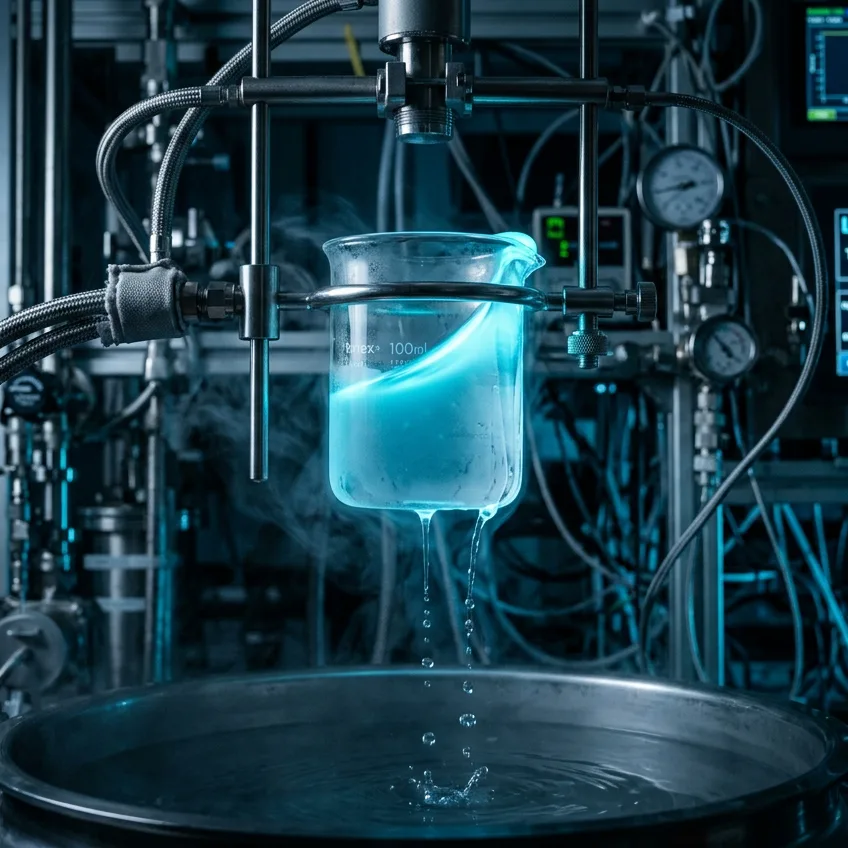
If a beaker is suspended partially submerged in a reservoir of superfluid helium, the liquid crawls up the outside, clears the top rim, and fills the beaker until both levels equalize. But the most striking phenomenon occurs when lifting the container into the air: free from apparent gravity and without mechanical pumps, the helium scales the inner wall, crosses the rim, descends along the outer surface, and drips continuously from the base until completely emptying the beaker.
Additionally, this quantum liquid exhibits a thermal conductivity millions of times higher than that of conventional helium. Due to this instantaneous heat dissipation, superfluid helium is incapable of boiling to produce bubbles: it remains in a glassy, perfect stillness while evaporating directly from the surface.
Source: Nature (1938) / American Physical Society (Physical Review Focus: The Rollin Film and Superfluidity)