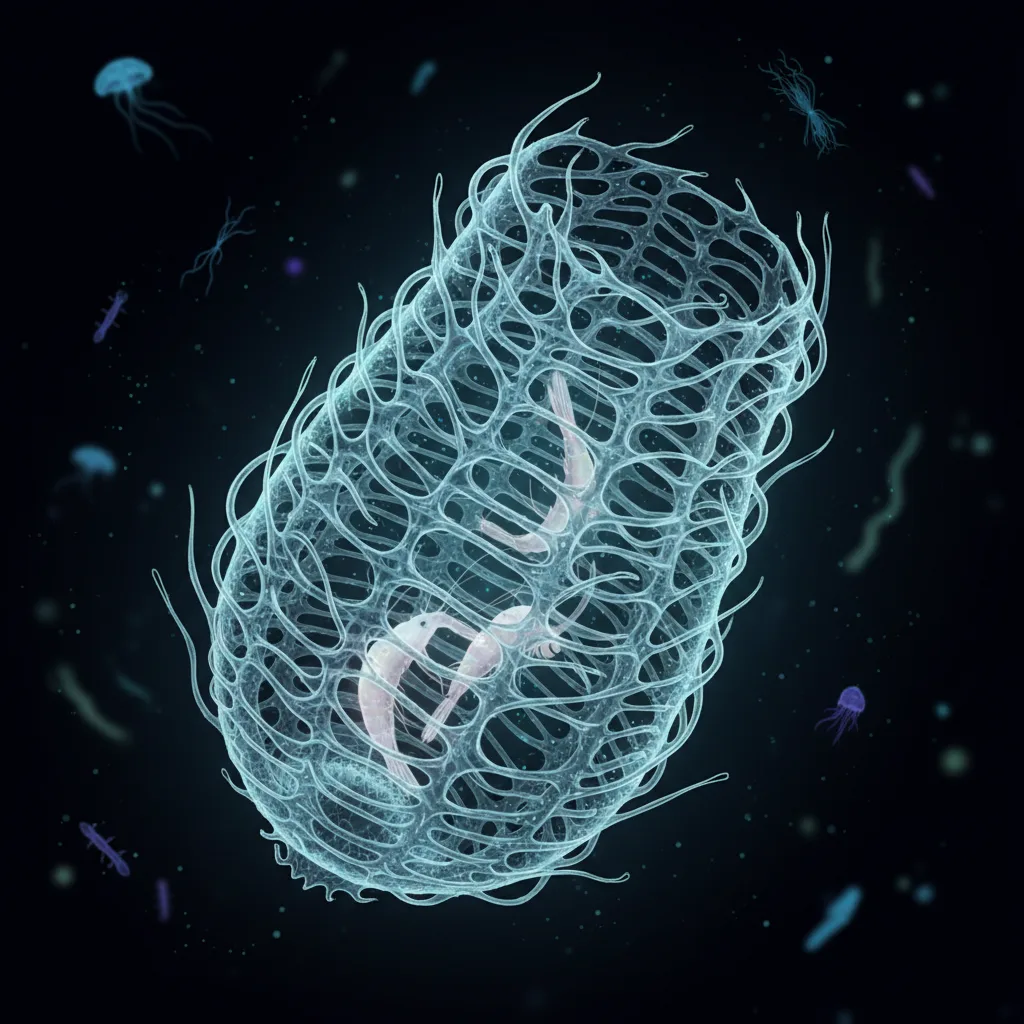
In the freezing, dark depths of the ocean, where sunlight never penetrates, flourishes one of nature's most amazing architectures: the glass sponge, scientifically known as Euplectella aspergillum, or "Venus' flower basket." This marine organism, found at depths of up to 1,000 meters, is famous for its intricate lattice skeleton, built entirely from pure silicon dioxide (silica), similar to fiber-optic glass.
What makes this sponge even more extraordinary is its construction method. Euplectellas "weave" a network of microscopic silica spicules that fuse together to form an incredibly strong and aesthetically flawless cylindrical structure. This lattice not only provides support and protection, but it also possesses surprising optical properties, functioning as a natural fiber-optic network.
Yet the mystery does not end there. Inside the sponge lives a pair of shrimp belonging to the genus Spongicola. Once these crustaceans enter the sponge during their larval stage, they grow until they become too large to escape the intricate structure. Thus, they live their entire lives inside this glass refuge, feeding on the nutrients the sponge filters and, in return, keeping the "house" clean. This is one of the most unique symbioses in the animal kingdom, a glass prison that is also a lifelong sanctuary.
Source: National Geographic, ScienceDirect, Nature Communications, Monterey Bay Aquarium Research Institute (MBARI)