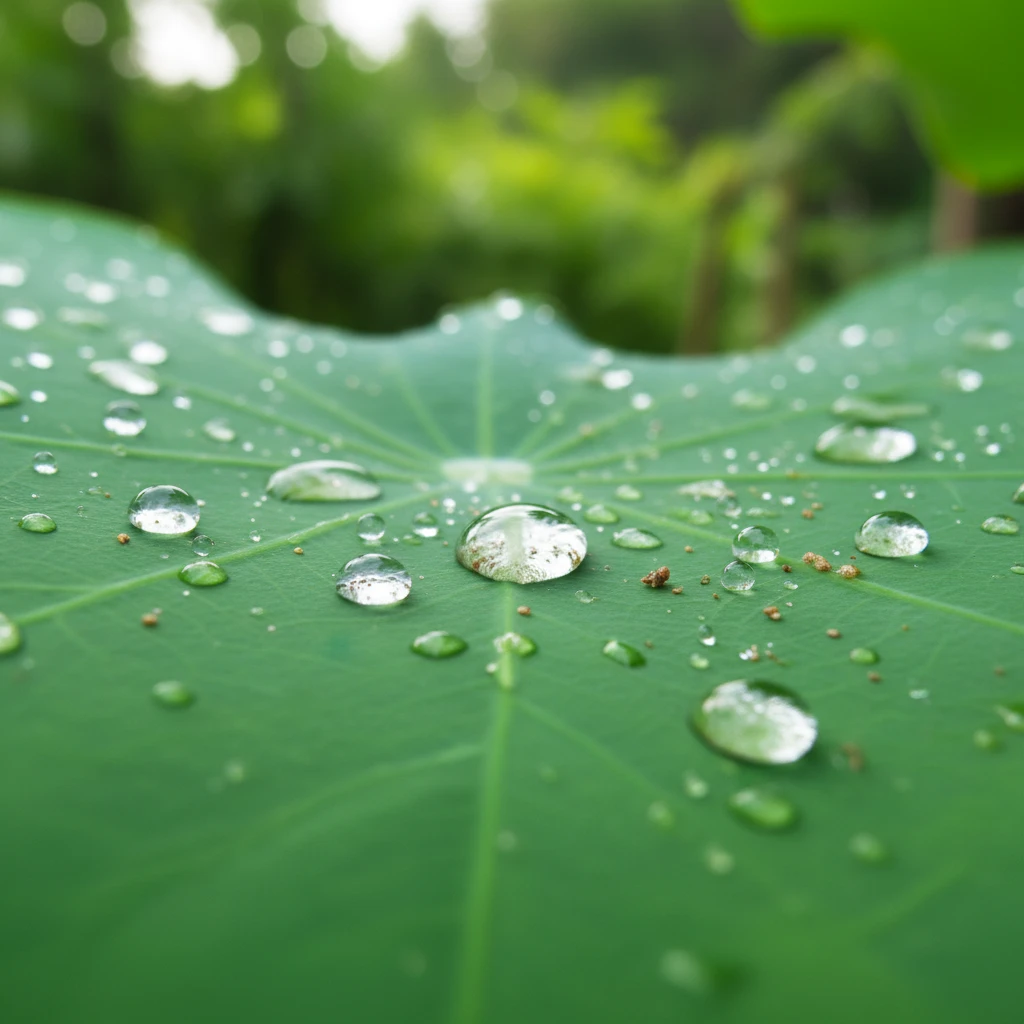
The next time you look at a lotus leaf, notice how water glides over it without wetting it, carrying away any dirt particles. This is the famous 'Lotus Effect,' a fascinating example of superhydrophobicity, the ability of a surface to repel water extremely well.
To the naked eye, lotus plant leaves seem smooth, but under a microscope, they reveal a surprisingly complex micro- and nano-textured structure. Their surface is covered by thousands of tiny bumps (microscopic papillae) and, on top of these, minute wax crystals at the nanometer scale. This dual roughness drastically reduces the contact area between water and the leaf surface. Instead of spreading out, water droplets take on an almost spherical shape, minimizing their adhesion.
When water falls onto the lotus leaf, it does not "wet" it in the traditional sense. As water droplets roll across the surface, they pick up dirt, dust, and even microorganisms, cleaning the leaf through a completely natural process. This self-cleaning mechanism not only keeps the leaf free of pathogens and optimizes photosynthesis by ensuring maximum exposure to sunlight, but it has also inspired scientists and engineers. They have replicated this effect to develop self-cleaning materials, stain-resistant paints, and waterproof textiles, proving once again how nature is the best teacher of innovation.
Source: Studies in botany, materials science, and biomimetics on the lotus plant.