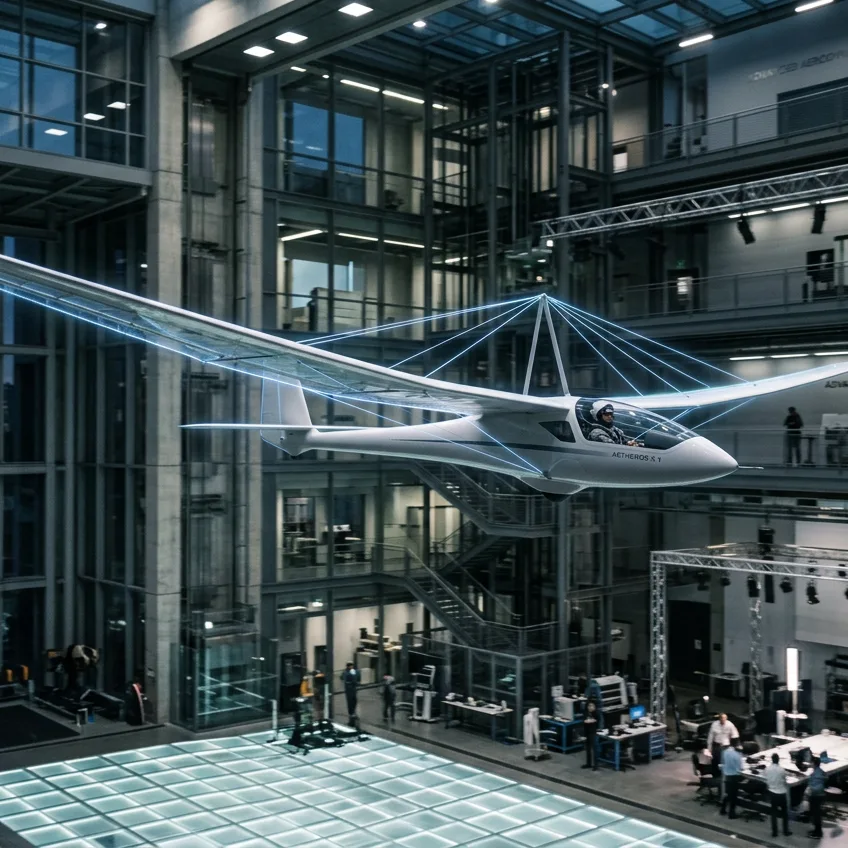
For over a century of modern aviation, flying always required moving mechanical parts: pistons, propellers, or the massive blades of jet turbines. However, in 2018, a team of engineers from the Massachusetts Institute of Technology (MIT), led by Steven Barrett, broke this paradigm by flying the first solid-state airplane in history: an aircraft without any conventional engine or moving parts.
The secret behind this feat is electroaerodynamic propulsion, commonly called ionic wind. The physical principle works through an extreme electrical cascade:
- At the front of the wings, thin metal filaments receive a discharge of 40,000 volts.
- This massive electric field strips electrons from the surrounding air, ionizing nitrogen molecules.
- The positively charged ions are drawn at high speed toward a negative receiving electrode located behind. Along their path, they collide with millions of neutral air molecules, transferring their momentum and creating a continuous stream of air that pushes the airplane forward.
The prototype, with a wingspan of five meters and weighing 2.45 kilograms, flew completely autonomously and in absolute silence across 60 meters in an indoor gymnasium. Although it is still in early stages for passenger aviation, this technology opens the door to ultra-silent surveillance drones and atmospheric transport systems without emissions or mechanical wear.
Source: Nature (Flight of an aeroplane with solid-state propulsion, Barrett et al., 2018)