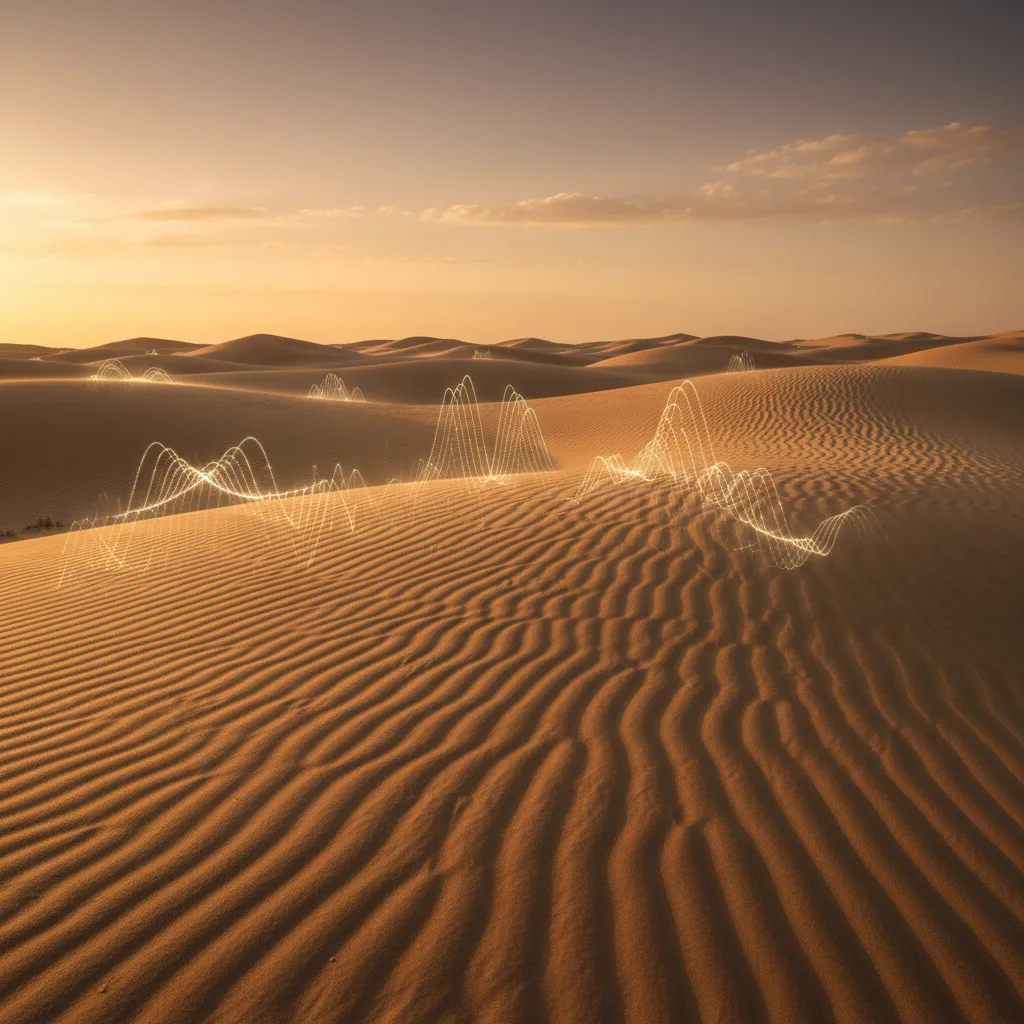
Imagine being in the heart of a vast desert, and suddenly, the ground beneath your feet begins to vibrate as a deep and resonant "song" emerges from the dunes, growing into a thunderous roar that travels for kilometers. This phenomenon, known as "singing dunes" or "booming sand", is one of nature's most enigmatic acoustic wonders.
It is not magic, but science in action. For a dune to "sing", very specific conditions are required: the sand must be almost perfectly dry, the grains must have a uniform size (generally between 0.1 and 0.5 millimeters) and be coated with a thin layer of silica. When the wind pushes large amounts of sand down the slope of a dune or when an explorer disturbs it by walking or sliding, the grains begin to vibrate in unison, generating sound waves. These collective vibrations are amplified by the body of the dune, transforming it into a gigantic natural musical instrument.
The sounds can vary from a low and constant hum to a roar resembling a jet plane, and sounds reminiscent of orchestral music or whale song have even been reported. This incredible phenomenon has been documented in various deserts around the world, including the Gobi Desert in Mongolia, the Sahara in Africa, and the Mojave Desert in the United States. Indigenous peoples and explorers throughout history have been fascinated and, often, terrified by these "living" dunes, attributing spirits or mystical powers to them. Modern science continues to study the physics behind this spectacle, seeking to unravel the secrets of collective resonance in sand to better understand the mechanics of granular materials.
Source: Scientific American - The Mystery of the Singing Sand Dunes, National Geographic - Booming Sands: A Natural Symphony, Journal of Geophysical Research: Earth Surface - Acoustic Emissions from Granular Flows in Singing Dunes