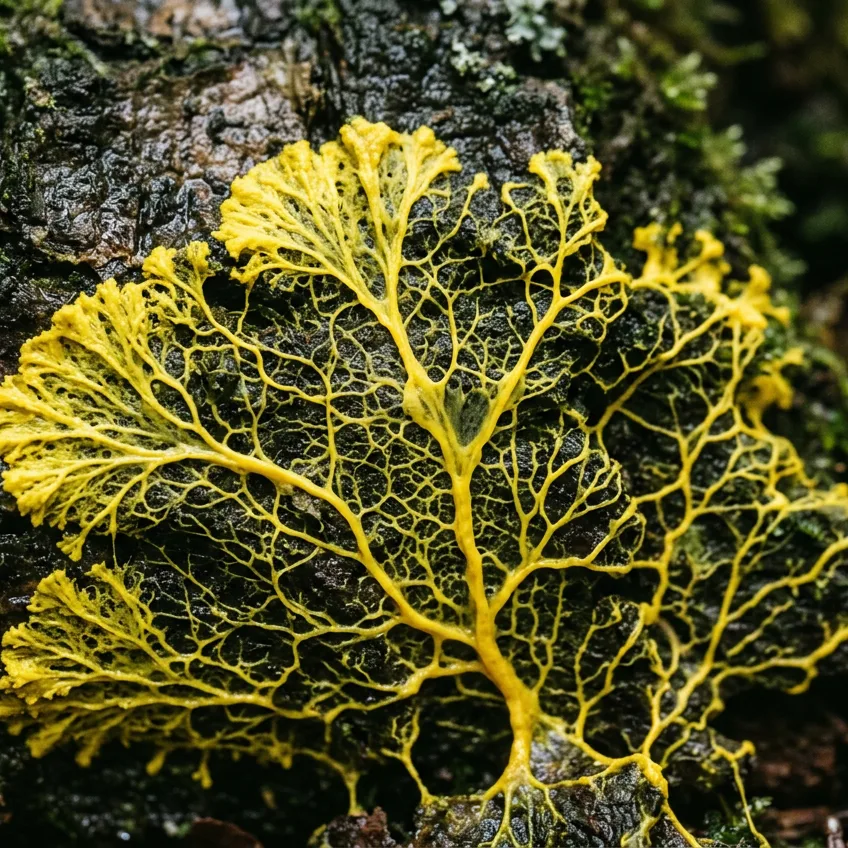
To the naked eye, Physarum polycephalum looks like a modest yellowish slime that colonizes damp, rotting logs. However, this giant single-celled organism—a syncytium formed by millions of nuclei sharing a single plasma membrane—hides one of the most astonishing biological computing abilities in the living world.
In 2000, Japanese biologist Toshiyuki Nakagaki placed fragments of this mold at the edges of a maze with oat flakes at the exit. Against all odds, the creature not only found the food, but it also retracted all its excess filaments to consolidate the shortest possible path. A decade later, researchers replicated the map of Tokyo's railway network by placing food on key station points; in a matter of hours, the mold traced a network of tubes nearly identical to the one designed by top human engineers, maximizing efficiency and fault tolerance.
Most baffling is its capacity for memory and learning without possessing a single neuron. Several experiments showed that if subjected to regular blasts of cold, dry air at one-hour intervals, the mold learns the pattern and reduces its locomotion speed right before the next blast occurs, even if scientists withhold the stimulus. Studies from Harvard University found that this memory is physically stored in the architecture of its network: the tubes that transport nutrients permanently widen or narrow in response to experience, functioning as a physical record analogous to the synaptic connections of a brain.
Source: Nature (Nakagaki et al., 2000: 'Maze-solving by an amoeboid organism') / Science (Tero et al., 2010)