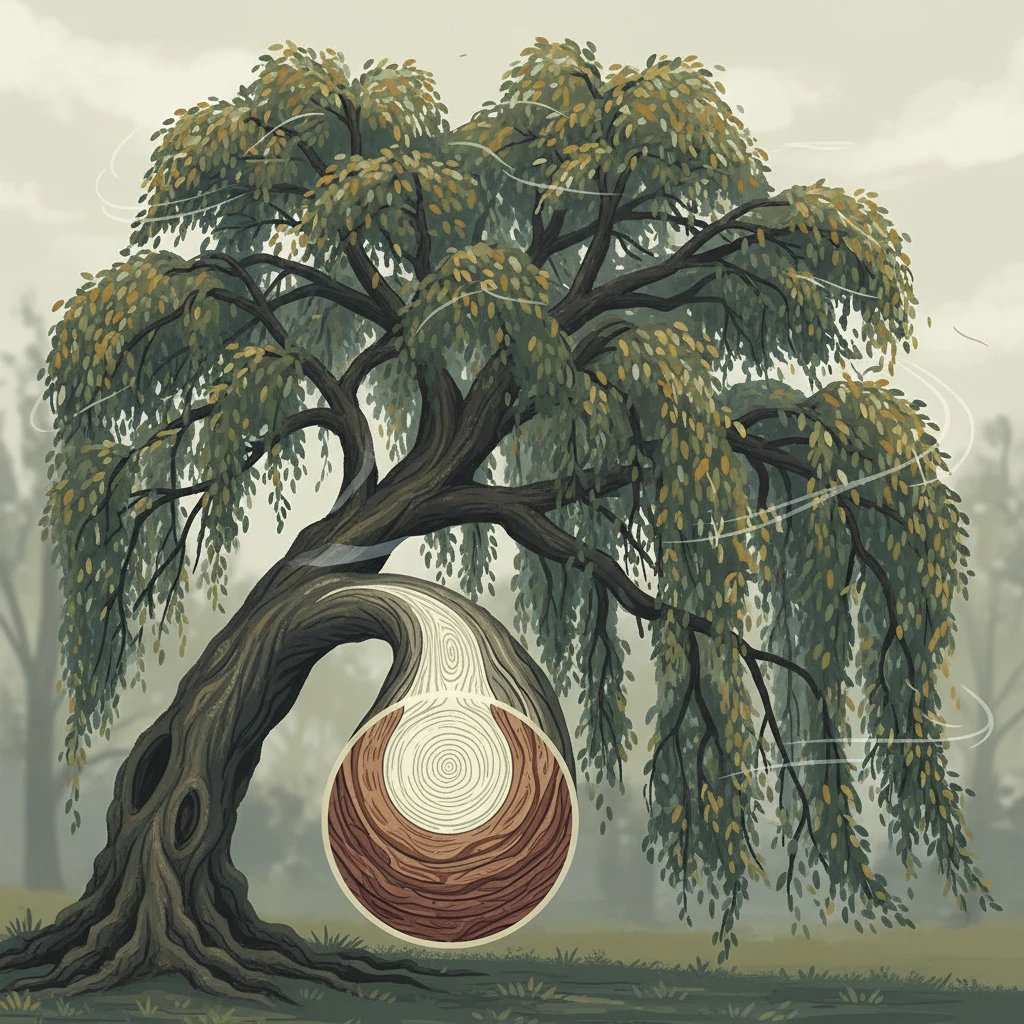
Imagine a living structure that not only grows toward the sky, but also senses the forces trying to knock it down and adjusts its composition to resist them. Trees are, in fact, masters of this "antigravity engineering" through a fascinating phenomenon known as reaction wood.
When a tree or branch deviates from its ideal vertical orientation due to wind, snow, or its own weight, it does not resign itself to falling. Instead, it activates an extraordinary biological mechanism. Cells in certain parts of the trunk or branches begin to grow differently, producing a special type of wood with unique mechanical properties.
There are two main types of reaction wood. In dicotyledons (most broadleaf trees), "tension wood" forms on the upper side of branches and the leaning trunk. This wood is rich in cellulose and has an incredible ability to contract, literally pulling the branch upward to correct its posture.
In conifers (trees such as pines and firs), "compression wood" develops on the lower side of branches and the trunk. This wood is rich in lignin and, unlike tension wood, has the ability to expand. In doing so, it pushes the branch or trunk upward, achieving the same realignment goal. This process not only ensures tree stability, but it is vital for the resilience of entire forests, showing a form of self-construction and adaptation that continues to inspire the field of biomimetics.
Source: Botanical Journal of the Linnean Society, Wood Science and Technology, plant biomechanics studies.



