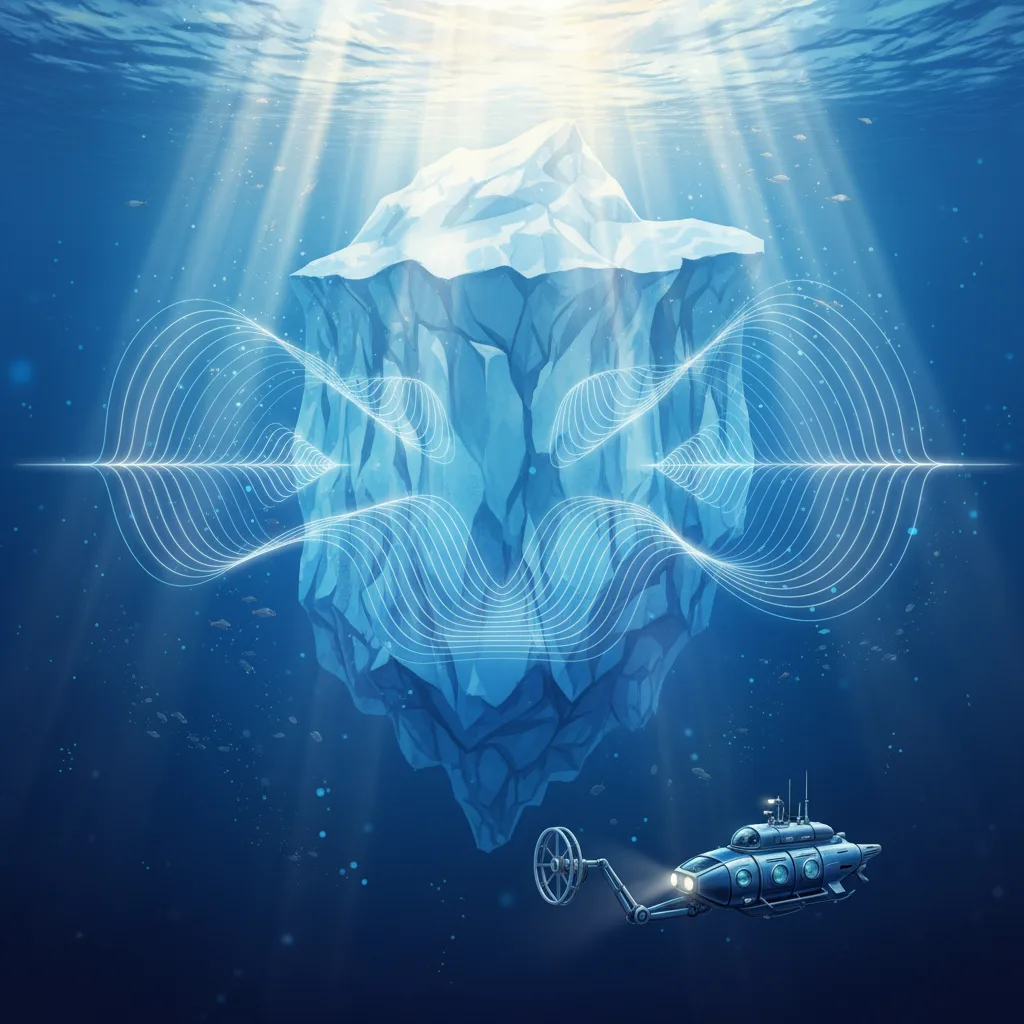
When we think of majestic glaciers and towering icebergs, we often imagine a cold, awe-inspiring silence. However, beneath the ocean surface, these colossi of ice are far from mute; in fact, they emit a complex and fascinating underwater "song", a symphony of nature that reveals much about their condition and the pulse of the planet.
These sounds range from subtle crackles and bubbling, produced by melting and the release of air trapped for thousands of years, to thunderous bursts and roars caused by the breaking off of gigantic blocks of ice (a phenomenon known as calving). Internal fractures and the friction of ice against the seafloor also contribute to this chorus.
Water is an excellent conductor of sound, allowing these vibrations to travel enormous distances. Scientists, using sensitive hydrophones, have begun to "listen" to and analyze these acoustic signals. By decoding the language of ice, they can monitor glacier dynamics in real time, estimate the rate of iceberg calving, and even predict potential collapses.
This "song" is also an early warning of climate change. As global temperatures rise, melting and ice calving accelerate, intensifying acoustic activity. The sounds of glaciers thus become a crucial auditory bioindicator, providing invaluable data to understand the impact of global warming on polar and marine ecosystems. It is a powerful reminder of how nature speaks to us, if only we know how to listen.
Source: Scientific journals of Glaciology, Oceanography, and Marine Bioacoustics.