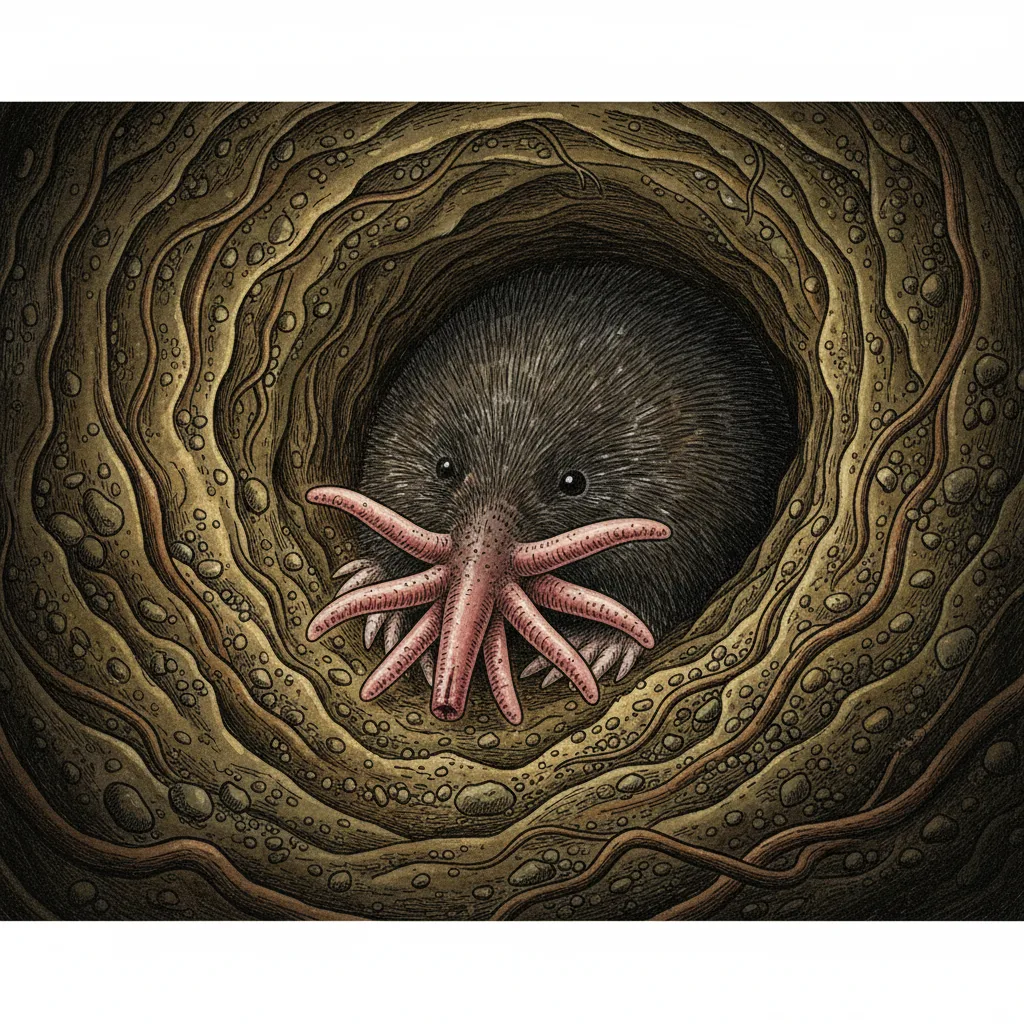
In the wetlands, bogs, and soft soils of North America lives a mammal that looks like something out of science fiction: the star-nosed mole (Condylura cristata). Although virtually blind, this peculiar animal does not need sight to hunt and navigate its complex underground and semi-aquatic world, a crucial adaptation for its survival.
Its most astonishing feature is undoubtedly its nose, equipped with 22 fleshy pink tentacles that extend and move at dizzying speeds. These appendages, arranged symmetrically around the nostrils in the shape of a star, are not merely aesthetic organs; they are a masterpiece of sensory evolution. They act as a kind of tactile eye, covered by more than 100,000 nerve endings that are extremely sensitive, making them six times more refined and responsive to touch than a human hand.
This tactile hypersensitivity allows the mole to identify and assess edible objects or prey in just 8 milliseconds. Once prey is located, it can devour it in less than a quarter of a second, a record that makes it the fastest mammal at identifying and consuming food. This extraordinary sense allows it to build a three-dimensional map of its surroundings in fractions of a second, detecting not only texture and shape, but also the slightest vibrations and electric fields that betray the presence of insects, larvae, or small invertebrates.
The star-nosed mole is a marvel of biological engineering, a testament to how nature can reinvent the senses so that a species can thrive in one of the most challenging environments.
Source: National Geographic, Smithsonian Magazine, Cornell University publications on animal biology.