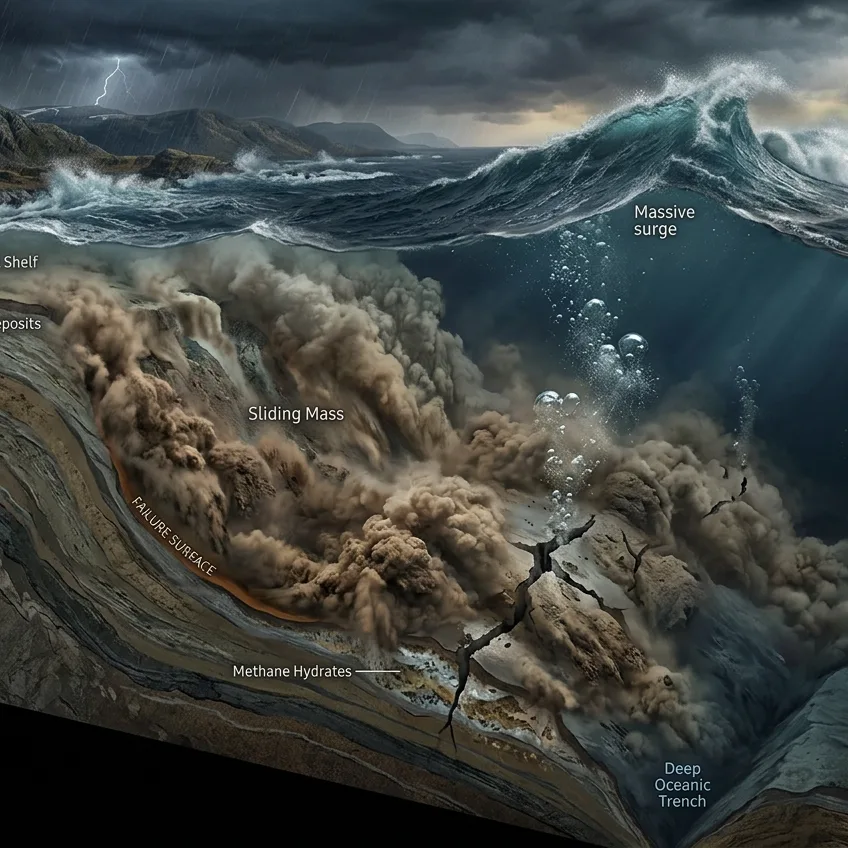
Beneath the waters of the Norwegian Sea lies the scar of the largest ground collapse recorded in the Holocene: the Storegga Slide. Around 8,200 years ago, a strip of the Norwegian continental shelf nearly three hundred kilometers long suddenly collapsed, plunging nearly 3,500 cubic kilometers of sediment into the oceanic abyss, a colossal volume capable of burying the entire Iberian Peninsula under several meters of mud and rock.
The trigger was a lethal geological combination that originated after the end of the last glacial period:
- Overburden instability: The rapid accumulation of glacial sediments over soft, water-saturated clays created an extremely fragile and hydrostatically overpressured base.
- Methane hydrate dissociation: Rising temperatures on the seabed destabilized the frozen gas trapped in rock pores, releasing pressurized gas pockets that lubricated the fault.
- A postglacial earthquake: The isostatic rebound of the crust as the glaciers melted caused an earthquake that suddenly fractured the continental slope.
The nearly instantaneous displacement of such an underwater mass triggered a catastrophic megatsunami in the North Atlantic. Waves exceeded twenty meters in height in the Shetland Islands, reached twelve meters in the Norwegian fjords, and penetrated dozens of kilometers inland in Scotland, leaving marine sand deposits that geologists still extract from inland peat bogs.
This geological catastrophe dealt the final blow to Doggerland, the vast and fertile plain that connected the British Isles with the Netherlands and Denmark. The tsunami flooded entire Mesolithic camps and accelerated Great Britain's definitive geographic isolation.
Source: Geological Society of London / Marine Geology