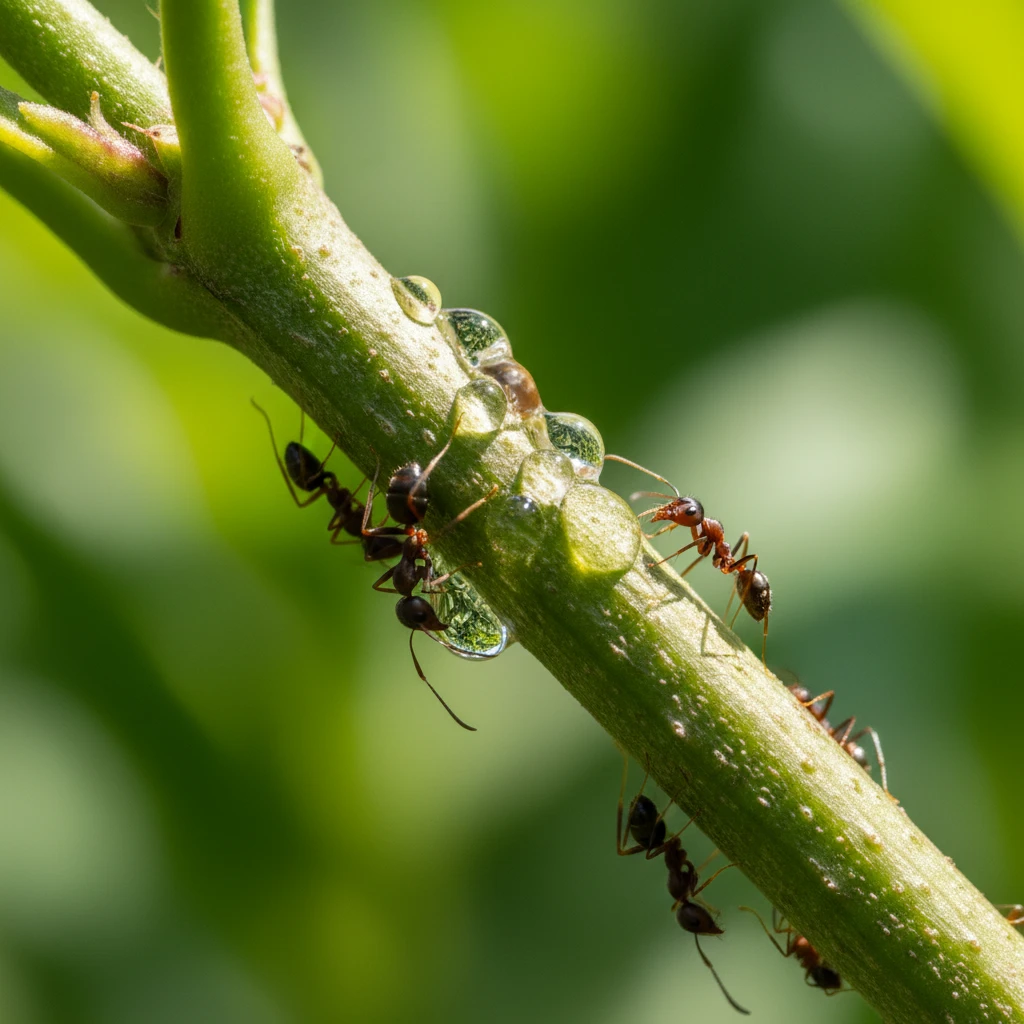
In the fascinating world of nature, survival often depends on ingenious alliances. One of the sweetest and most surprising is the one established by some plants with armies of ants, a relationship where nectar becomes a vital currency.
Far from being a mere attraction for pollinators, certain trees and plants have developed extrafloral nectaries: specialized glands that secrete a sugary substance directly from their leaves, stems, or petioles, without being associated with flowers. This "weeping nectar" does not seek to attract bees, but rather to recruit the fiercest protectors in the insect kingdom: ants.
When a herbivore, such as a caterpillar or a beetle, attempts to feed on these plants, the ants, tirelessly patrolling the stems and leaves in search of their sweet reward, act as an instant security system. They attack and drive away the invaders, defending their food source with remarkable aggressiveness. It is a classic example of mutualism, where both species benefit: the plant gains protection against predators and the ants receive a steady source of energy-rich food.
This system has been observed in a wide variety of species, from the towering acacias of Africa, which house entire ant colonies inside their hollow thorns, to the humble passionflower and some cotton species. It is eloquent proof of how evolution has sculpted complex and efficient interactions, transforming a simple sugar secretion into a sophisticated defense strategy that ensures prosperity in the plant kingdom.
Source: Botany and ecology journals, studies on plant-insect mutualism, National Geographic.



