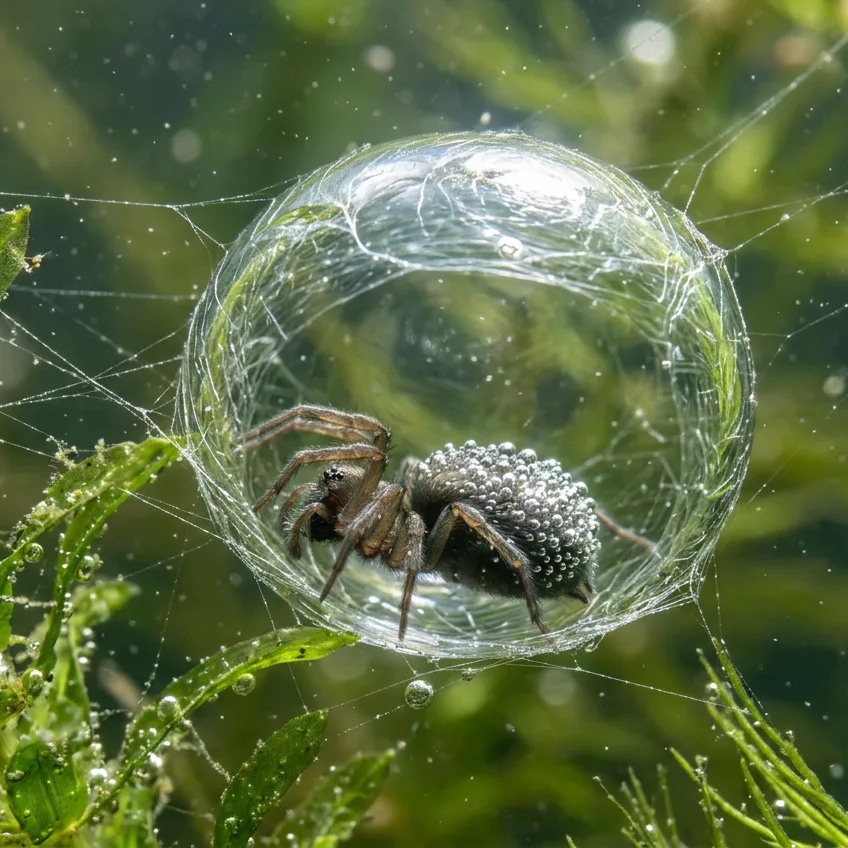
Unlike all its terrestrial relatives, the water spider (Argyroneta aquatica) spends virtually its entire existence submerged in ponds, lakes, and slow-moving streams. Because it lacks gills and retains the air-breathing respiratory system of arachnids, this species solved the dilemma of suffocation through a biomechanical feat: building its own silk diving bell.
To create this submerged shelter, the spider weaves a dense web of hydrophobic silk anchored among aquatic vegetation. Afterwards, it ascends to the surface, pokes out the tip of its abdomen, and traps an air bubble with the help of thousands of specialized microscopic hairs. Upon diving back down, it releases this cargo inside the silk structure, repeating the process until inflating a shiny spherical chamber.
What is truly extraordinary, confirmed by research from the Journal of Experimental Biology, is that the bubble is not a simple static store of air. It functions as an active physical gill: as the spider consumes oxygen inside, the partial pressure difference causes oxygen dissolved in the surrounding water to diffuse into the membrane, while expelled carbon dioxide dissolves into the water outside. Thanks to this passive gas exchange, the spider can rest, hunt aquatic prey, and even reproduce underwater for more than 24 consecutive hours without needing to surface.
Source: Journal of Experimental Biology



